






Black Friday 2026 Forecast: What European Online Retailers Can Expect
- Kategorien:
- Categories:
- Performance
TL;DR
- So far, a forecast for 2026 is only available for the US. No forecasts are available for Europe yet. We therefore look at how Black Friday 2025 performed in five European markets.
- US, 2026 forecast: Bain & Company expects sales of over $85 billion from Black Friday to Cyber Monday, an increase of 8.75 percent.
- Europe, 2025 data: In several markets, the promotional period starts well before Black Friday and extends beyond Cyber Monday.
- Market trends vary: Germany expected sales to decline for the first time, Belgium reported a record day, and France saw strong growth, particularly online.
- In the Netherlands, iDEAL transactions in the seven days leading up to Black Friday rose from 23 million in 2020 to 37.8 million in 2025.
- Market researchers now refer to Black Week, Black November or even Black Month.
$85 billion in four days. That is how much US consumers are expected to spend from Black Friday to Cyber Monday 2026, according to a forecast by consulting firm Bain & Company. Spending over the weekend is thus growing almost twice as fast as spending over the holiday shopping season as a whole.
And in Europe? No comparable forecast for 2026 is available here yet. We therefore compared Bain’s figures with the 2025 results from Germany, the UK, the Netherlands, Belgium and France. The comparison shows that promotional campaigns begin as early as mid-November in several markets. However, sales and consumers’ willingness to spend vary considerably from country to country.
This is the second part of our Black Friday series. To find out which dates matter during peak season and what you should check in your online store beforehand, read the first part: “Black Friday 2026: 5 tips for your online store during peak season”.
US Black Friday Forecast 2026: What Bain Expects
The forecast comes from Bain's retail team. It is based on data from the US Census Bureau, card transaction data from Pyxis, Bain's consumer analytics division, and a survey of 1,105 US consumers (source: Bain & Company, 2026). All figures in this section refer to the US and to 2026.
1. Black Friday weekend is growing faster than the season as a whole
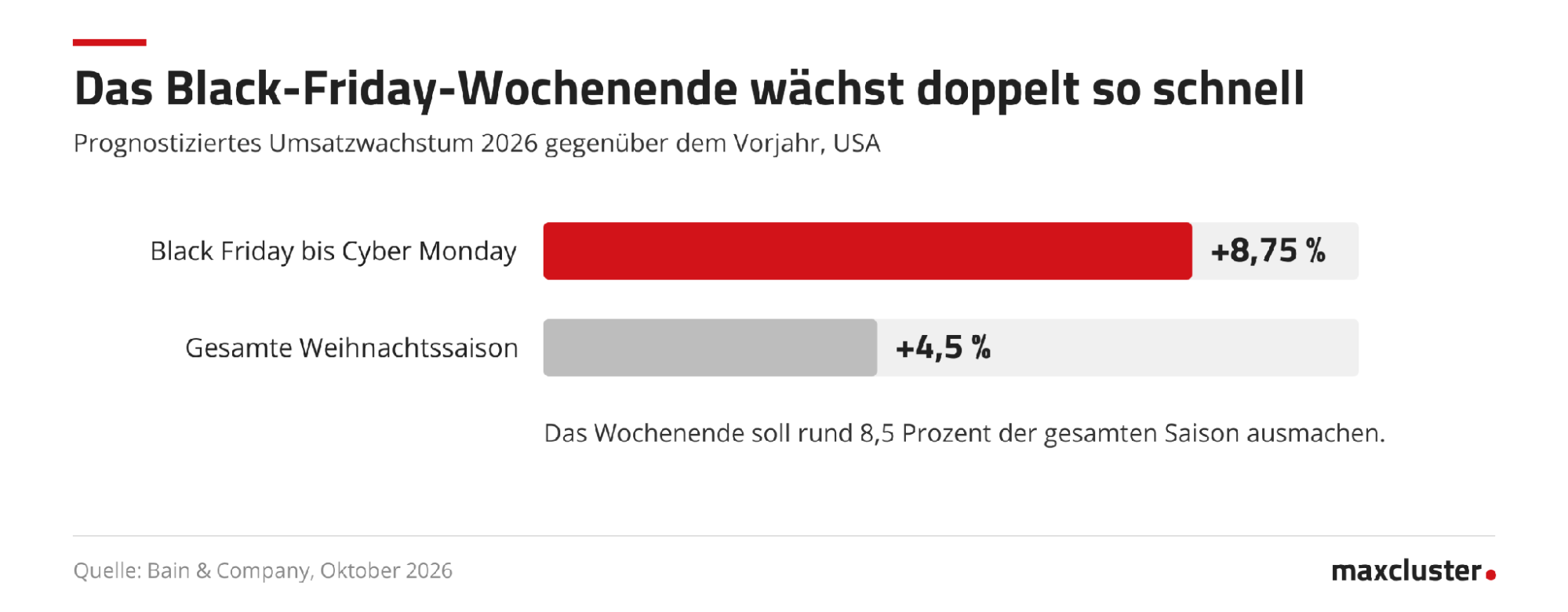
According to Bain, US shoppers plan to spend more than $85 billion from Black Friday to Cyber Monday. That represents around 8.5 percent of total holiday sales. More interesting than the total is the growth rate: Bain expects sales over the promotional weekend to rise by 8.75 percent, compared with 4.5 percent for the season as a whole. Total sales for the season are expected to exceed $1 trillion for the first time (source: Bain & Company, 2026).
2. 64 percent plan to shop on Black Friday
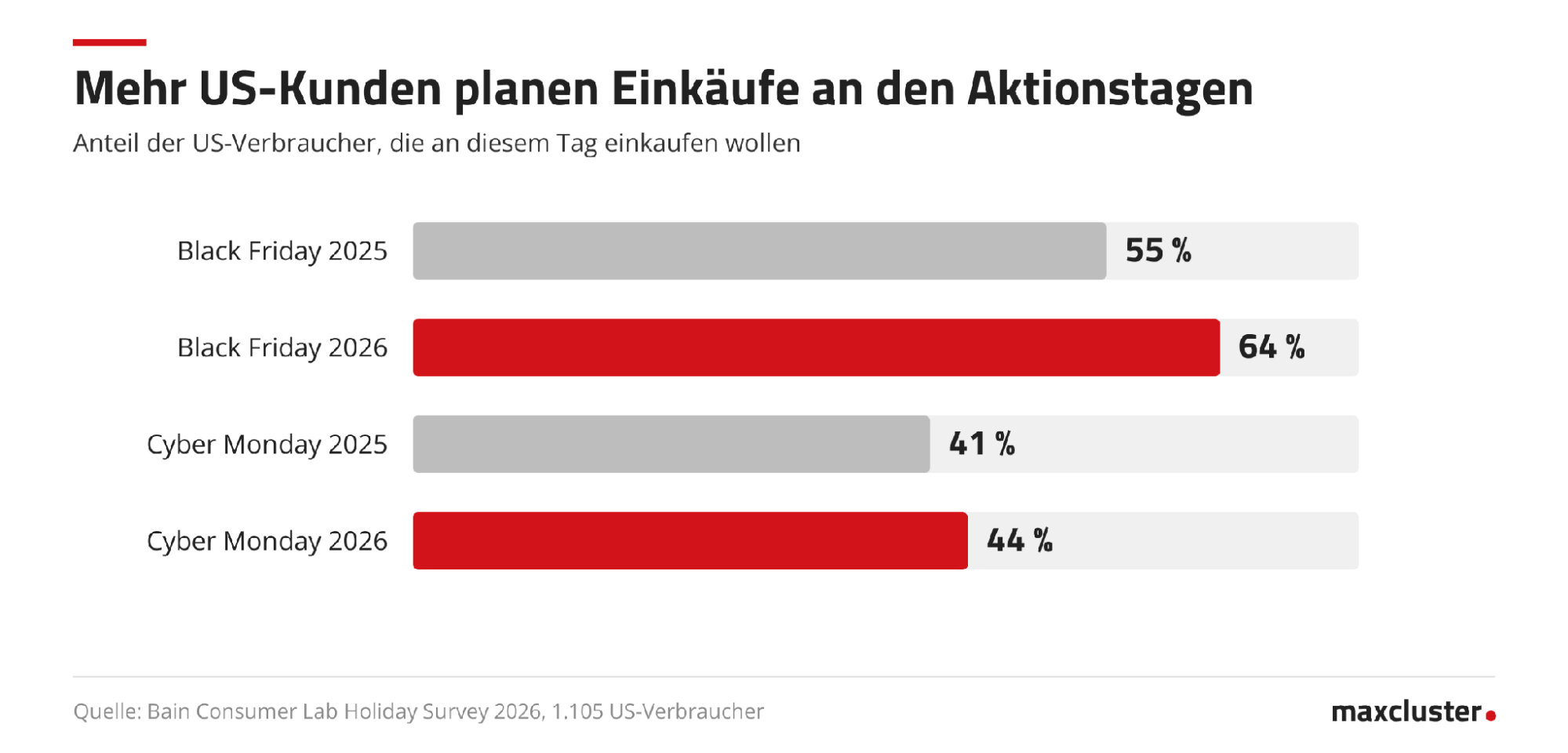
More than 90 percent of US consumers plan to shop on Black Friday, Cyber Monday or another major promotional day this year. For Black Friday itself, the figure is 64 percent, up from 55 percent last year (source: Bain & Company, 2026).
At the same time, more than half plan to change their spending habits this season, partly because of higher prices (source: Bain & Company, 2026). Shoppers will turn up. But they will only buy if the offer is truly compelling.
3. Black Friday leads, Cyber Monday catches up
According to Pyxis card transaction data, Black Friday was the highest-grossing day of the US holiday season in five of the past six years. Cyber Monday dropped out of the top 10 after 2020 but returned in 2024. Bain expects it to rank among the top five days in 2026. Of those surveyed, 44 percent plan to shop on Cyber Monday, up from 41 percent last year (source: Bain & Company, 2026).
4. It does not end with Cyber Monday
In 2025, six of the ten highest-grossing US shopping days fell in the final stretch before Christmas, mostly on Fridays and Saturdays. In 2026, Christmas falls on a Friday. Bain therefore expects weekdays in the final week before Christmas to perform more strongly than usual as well (source: Bain & Company, 2026).
In short: In the US, sales over the promotional weekend are forecast to grow by 8.75 percent in 2026, compared with 4.5 percent for the season as a whole. Strong sales days also continue after Cyber Monday until shortly before Christmas. Market data from 2025 shows which of these trends are also emerging in Europe.
Black Friday 2025 in Europe: a comparison of five markets
Amazon brought Black Friday to the UK in 2010, and it had become mainstream there by 2013 at the latest. The German Retail Federation (HDE) has been tracking sales since 2016. Since then, the shopping event has become established across Europe.
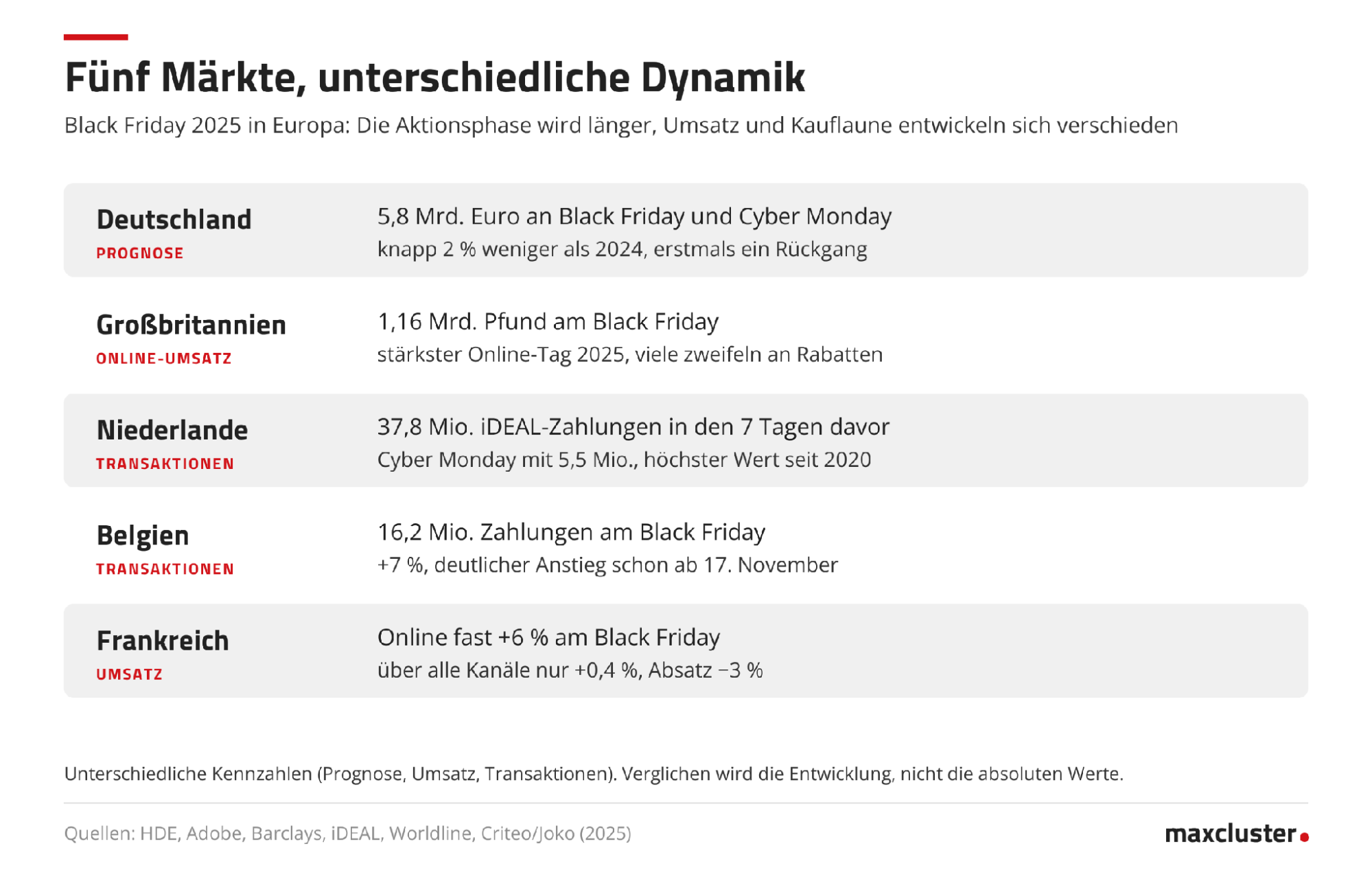
A quick note: each country measures Black Friday differently. Some sources count card payments, some count online transactions, and others publish only forecasts. Rather than comparing the figures directly, we therefore look at trends in each individual market.
Germany: more shoppers, smaller budgets
For a long time, Black Friday in Germany moved in only one direction. Since the HDE began tracking sales in 2016, Black Friday and Cyber Monday sales rose every year, sometimes by more than 20 per cent. In 2024, sales levelled off at a high level. For 2025, the HDE forecast a decline for the first time: €5.8 billion, down almost 2 per cent on the previous year (source: HDE, 2025).
Interest was still strong, however. According to an HDE survey, 48 per cent of online shoppers intended to shop on Black Friday in 2025, more than in the previous year. They simply planned to spend less. The HDE attributes this to persistently weak consumer sentiment (source: HDE, 2025). Germany therefore shows the same pattern: interest in Black Friday remains high, while consumers are watching their spending more closely.
UK: bigger budgets, little trust
Ahead of Black Friday 2025, British shoppers planned to spend an average of £430, according to a Barclays survey—£91 more than in the previous year. One in four had saved specifically for the sales. At the same time, 68 per cent doubted the real value of the deals, and 65 per cent felt that shopping events like these encouraged unnecessary purchases (source: Barclays via Retail Times, 2025).
Shoppers still made purchases: according to an Adobe analysis, Black Friday 2025 was the UK's biggest online shopping day of the year, generating £1.16 billion in online sales. Across the entire Cyber Weekend, from Black Friday to Cyber Monday, online sales totalled £3.8 billion (source: Adobe via IT Brief UK, 2026).
Netherlands: growth in the week before Black Friday
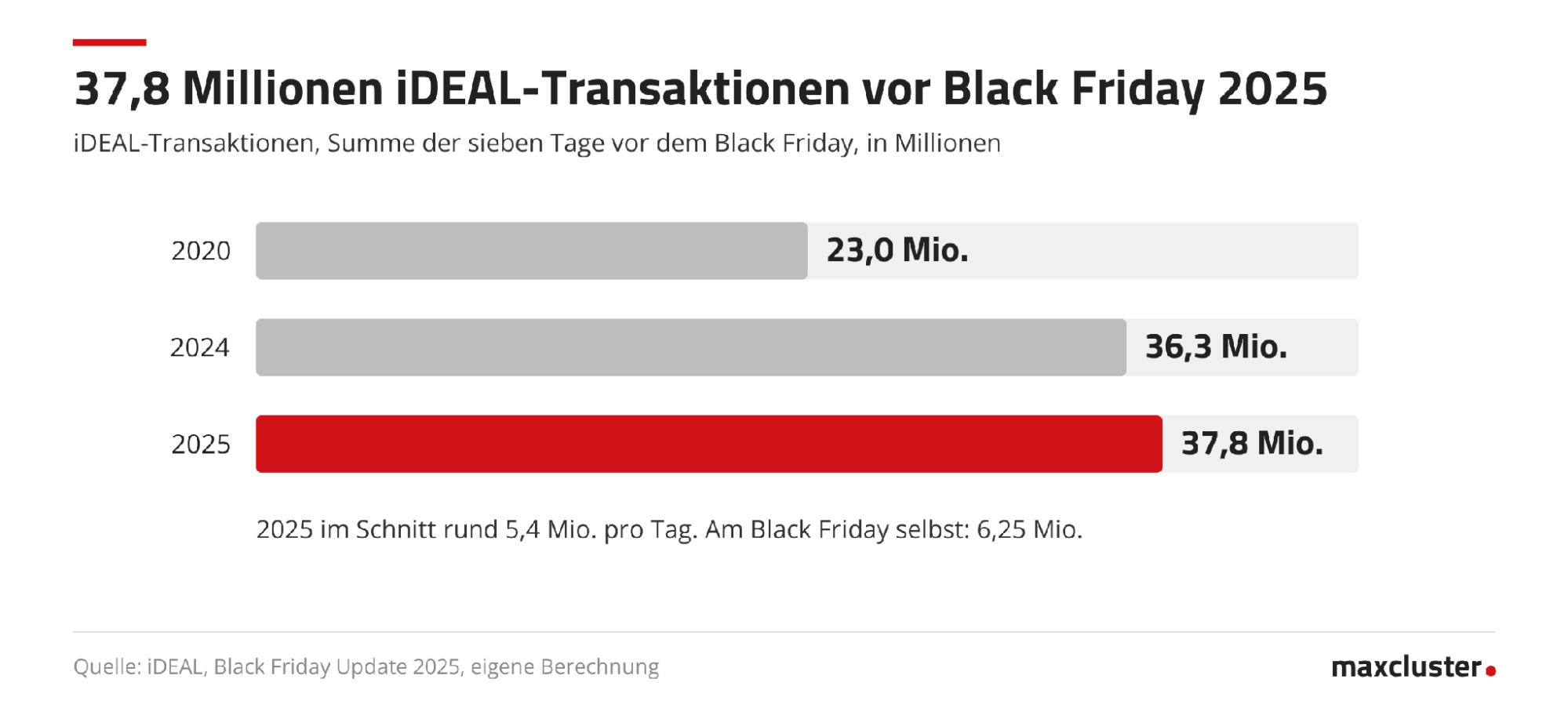
iDEAL, the leading online payment method in the Netherlands, publishes daily transaction figures around Black Friday. On Black Friday 2025, it recorded around 6.25 million transactions. That was more than in the previous year, but below the 7.13 million recorded in 2023 (source: iDEAL, 2025).
The preceding week, by contrast, saw significant growth. In the seven days before Black Friday, iDEAL recorded a total of around 37.8 million transactions in 2025, compared with just 23 million in 2020. That amounts to an average of around 5.4 million per day in 2025—not much less than on Black Friday itself. Cyber Monday also grew, from 3.44 million transactions in 2020 to 5.50 million in 2025. This is the highest figure since the records began in 2020 and around 8 per cent more than in 2024 (source: iDEAL, 2025).
The Netherlands also celebrates Sinterklaas on 5 December, which in 2026 falls just eight days after Black Friday. Much like St Nicholas Day in Germany, it brings another wave of gift-giving.
Belgium and France: a longer shopping period and a stronger shift online
In Belgium, Black Friday 2025 saw the highest number of transactions ever recorded by payment provider Worldline: 16.2 million, up 7 per cent on the previous year. Figures had already begun rising sharply from 17 November. Worldline now sees the second half of November as an established shopping period. Cyber Monday added almost 13 million transactions, 30 per cent of them online (source: Worldline, 2025).
In France, Black Friday growth was mainly online. Criteo recorded around 3 per cent more online transactions and almost 6 per cent more online sales. Across all channels, however, sales rose by just 0.4 per cent, according to an analysis by shopping app Joko, while the number of items sold fell by 3 per cent. Joko examined an eleven-day Black Week from 21 November to 1 December, during which 55 per cent of purchases were made online (source: FashionUnited, 2025).
Black Week, Black November or Black Month?
In the first part, we described how peak season stretches over several weeks. Data from five markets shows how much this can vary.
Even market researchers are now struggling with the term Black Friday. Marten Suurmeijer, an analyst at NielsenIQ, told the Dutch news agency ANP that we could “almost call it a Black Month” (source: ANP via Welingelichte Kringen, 2025). This trend is already emerging in the Netherlands and Belgium. In Germany, the figures mainly point to more cautious customers. And in France, growth is primarily in online sales, while overall sales are barely rising.
What does this mean for Black Friday 2026 in Europe?
There is no forecast comparable to Bain’s for Europe yet. Forecasts for 2026, including from the German Retail Federation (HDE), were not yet available at the editorial deadline. However, the 2025 data reveal four trends that are also relevant to planning for the 2026 peak season:
The promotional period starts earlier. In Belgium, payments were already rising from mid-November, while in the Netherlands, the week before Black Friday has been growing for years. Friday itself remains strong, but is increasingly no longer the starting point.
Cyber Monday remains relevant. In the Netherlands, iDEAL transactions on Cyber Monday have been rising for years. In 2025, they reached 5.50 million, around 8 percent more than the previous year. In Belgium, Worldline recorded almost 13 million transactions on Cyber Monday, 30 percent of them online. Worldline does not provide a year-on-year comparison for these figures. This data does not establish whether Cyber Monday is catching up in Europe as it is in the US. For planning in 2026, however, the message is clear: the Monday after Black Friday should be a core part of the promotional period.
Spending trends vary considerably by market. In the UK, shoppers planned larger budgets, but 68 percent questioned the value of the discounts. In Germany, more people intended to shop on Black Friday than in the previous year, but with smaller budgets. In France, the number of items sold fell by 3 percent.
E-commerce remains a key growth driver. In France, online transactions on Black Friday 2025 rose by around 3 percent and online revenue by almost 6 percent, while revenue across all channels barely increased. In the UK, Black Friday was the biggest online shopping day of the year, according to Adobe. These figures do not show whether online sales account for a growing share of total promotional sales in Europe. For online stores, however, these promotional days remain a key sales opportunity, even when the overall market is barely growing.
How strongly these trends emerge in Germany in 2026 also depends on consumer sentiment. According to the HDE Consumer Barometer, sentiment deteriorated significantly in October 2026, with willingness to buy well below the previous year’s level (source: HDE, 2026).
Black Friday hosting: What market data means for your infrastructure
The 2025 figures reveal specific infrastructure requirements. The table shows which trends lead to which requirements:
| What the 2025 data shows | What this means for infrastructure |
|---|---|
| Belgium: Transactions rose significantly as early as November 17 (Worldline). | Additional resources should be in place before mid-November. |
| Netherlands: In the week before Black Friday, there were around 5.4 million iDEAL transactions per day on average, rising to 6.25 million on Black Friday itself. | The load remains high for several days. The shop must handle it throughout the week without page load times increasing. |
| Cyber Monday: 5.50 million iDEAL transactions in the Netherlands (around 8 percent more than in 2024), and almost 13 million transactions in Belgium. | Do not scale back additional capacity immediately after Black Friday. The Christmas shopping season follows, along with Sinterklaas on December 5 in the Netherlands. |
| France: According to Joko, Black Week lasted eleven days, from November 21 to December 1. | Monitoring should cover the entire promotional period, including the days after the weekend. |
| France: Online sales on Black Friday were up almost 6 percent, compared with 0.4 percent across all channels. United Kingdom: Black Friday was the biggest online shopping day of the year. | Outages or long page load times hit the very channel that is growing during these promotional events. |
At maxcluster, our team proactively monitors shops around the clock. Our cluster architecture with failover is designed for 99.99 percent availability. Our Linux administrators are available at any time, with a response time of 90, 30 or 15 minutes, depending on the service level.
In practice: Bedre Nætter during Black Week
Danish online retailer Bedre Nætter sells beds and mattresses exclusively online through a Magento shop. Before switching to maxcluster, promotions and Black Week repeatedly led to outages and long page load times. At times, customers even had to pass through a virtual queue before entering the shop. Today, outages lasting several minutes during Black Week are a thing of the past, page load times have improved, and the queue is no longer needed (source: maxcluster case study).
For this period, we offer our Seasons program. In 2026, it starts on November 5. Read how we support our customers during this time in the first part of our series: “Black Friday 2026: 5 Tips for Your Online Shop During Peak Season”.
Conclusion
Bain’s forecast projects that sales over the promotional weekend in the US will grow by 8.75 percent in 2026—almost twice as fast as sales over the season as a whole. No comparable forecast is available for Europe yet.
The 2025 data shows just how much markets differ. In the Netherlands, 37.8 million iDEAL transactions were recorded in the week before Black Friday, while Belgium reported a record day with 16.2 million transactions. In France, growth was driven primarily by online sales. In Germany, by contrast, the German Retail Association (HDE) expected a decline for the first time, to €5.8 billion.
Planning promotions over several weeks and wondering whether your hosting can handle the load? Let’s take a look at your peak season together.
FAQ: Common questions about the Black Friday forecast for 2026
Is there a Black Friday forecast for Germany for 2026?
Not at the time this article was published. The German Retail Federation (HDE) usually releases its forecast for Black Friday and Cyber Monday in mid-November; in 2025, it was published on November 17. At the time, the association expected sales of €5.8 billion, down just under 2 percent on the previous year. The HDE Consumer Barometer offers an early indication for 2026: consumer sentiment deteriorated significantly in October 2026 (source: HDE, 2026).
How much revenue is expected for Black Friday 2026?
In the US, Bain & Company expects sales of more than $85 billion from Black Friday through Cyber Monday 2026, up 8.75 percent on the previous year. No comparable figures are available for Europe yet. For context, Adobe reported UK online sales of £1.16 billion on Black Friday 2025 and £3.8 billion across the entire Cyber Weekend.
How did Black Friday 2025 perform in Europe?
Results varied considerably by country. In Germany, the HDE forecast a sales decline for the first time, of just under 2 percent. In the UK, Black Friday was the biggest online shopping day of the year, according to Adobe. In the Netherlands, growth was concentrated in the week before Black Friday, while in Belgium, Worldline reported a record 16.2 million transactions. In France, online sales rose by almost 6 percent according to Criteo, while sales across all channels increased by just 0.4 percent according to Joko.
What does Black Month mean?
The term describes how the promotional period around Black Friday extends over several weeks. Many retailers launch their discounts as early as mid-November. Black Friday is followed by Cyber Monday, which then leads almost seamlessly into the Christmas shopping season. Marten Suurmeijer of NielsenIQ, for example, used the term when discussing the Netherlands. However, the extent to which Black Month takes hold varies from country to country.
