






Black Friday 2026: 5 Tips for Your Online Store During Peak Season
- Kategorien:
- Categories:
- Performance

TL;DR
- Black Friday falls on November 27, 2026, and Cyber Monday on November 30. However, peak season runs from Singles’ Day (November 11) through the period between Christmas and New Year.
- Surveys show that more Germans plan to shop on Black Friday in 2026 than in the previous year. At the same time, customers are comparing offers more carefully and increasingly using AI to do so.
- For your online store, this means preparing not just for a single day, but for multiple traffic spikes over approximately eight weeks.
- Our five tips: Analyze your 2025 data, coordinate promotions and technical preparations, test your checkout under load, plan your hosting requirements early, and clarify responsibilities.
- You'll also find actionable to-dos for four key trends and a practical checklist to tick off.
- At maxcluster, we support our customers throughout the entire peak season, starting November 5.
Surveys show that Black Friday will become even more important for online stores in 2026. According to idealo, 73 percent of Germans plan to shop on November 27, up from 65 percent last year (source: idealo, 2026).
To turn this interest into orders, your store needs to be ready. Many customers compare their options carefully. If a product page loads slowly during a promotion or checkout doesn't run smoothly, they'll shop elsewhere. What's more, Black Friday is just one of many dates: several promotional events follow in quick succession between Singles Day and the end of the year.
In this article, we'll show you how to prepare your store for peak season step by step, with five tips, practical tasks addressing the key trends, and a checklist to work through. You'll also learn how we at maxcluster support our customers throughout the entire peak season.
Peak Season 2026: Key Dates at a Glance
Peak season does not begin with Black Friday. For many retailers, Singles Day marks the start, followed by an almost uninterrupted run through to Christmas.
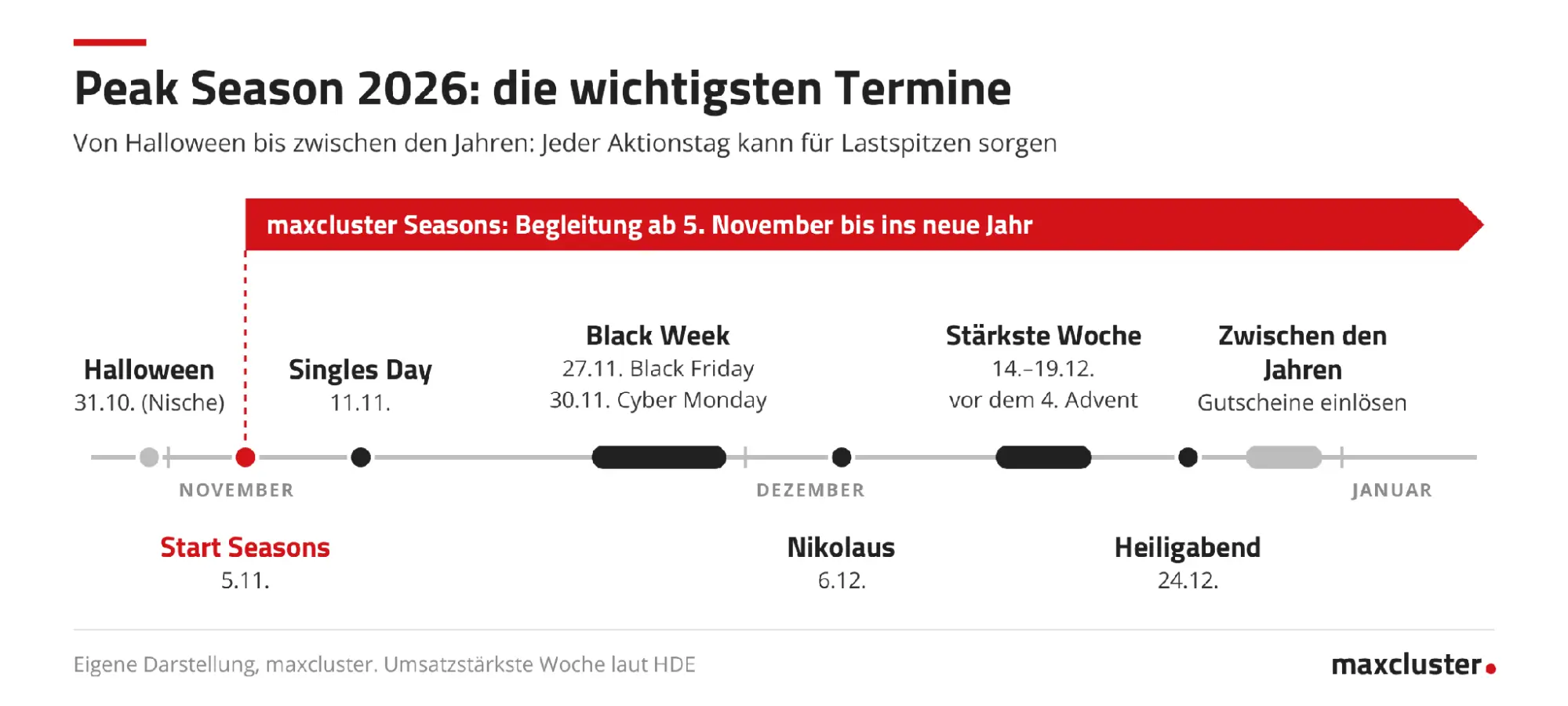
Halloween (31 October): The day is worthwhile for shops selling costumes, decorations or sweets. In 2025, the German Retail Federation (HDE) forecast €520 million in sales around Halloween (source: HDE via Lebensmittel Praxis, 2025).
Singles Day (11 November): The shopping event from China has also become established in Germany, including at Otto, MediaMarkt and Saturn. According to t3n, 11 November was one of the strongest sales days that month for several retailers (source: t3n, 2025).
Black Week (until 30 November): Black Friday falls on 27 November, and Cyber Monday on 30 November. Many retailers launch their discounts several days earlier.
Christmas shopping season (December): According to HDE, the week before the fourth Sunday of Advent generates the highest sales during the Christmas shopping season. In 2026, this is the week of 14–19 December (source: HDE via Lebensmittel Praxis, 2025).
Between Christmas and New Year (27–31 December): After Christmas, many customers redeem gift vouchers or spend money they received as gifts. In an HDE survey, 14 percent of retailers even named this period as their strongest for sales during the entire Christmas shopping season (source: HDE via ChannelPartner, 2025).
Black Friday and the 2026 holiday shopping season: What the numbers mean for your planning
Online retail remains an important sales channel beyond Black Friday. For the 2025 Christmas shopping season, the German Retail Federation (HDE) expected sales of €126.2 billion, including €22.2 billion in online sales, an increase of 3.3% (source: HDE, 2025). For 2026, the association forecasts overall online retail growth of 4.3% (source: HDE via the Bavarian Retail Association, 2026).
For your planning, this means demand is there. What matters is turning that demand into orders in your shop.
Read the second part of our series to find out how Black Friday has developed in Germany and other European markets, and what the forecasts are for 2026.
| Metric | 2025 | 2026 | Source |
|---|---|---|---|
| Black Friday / Cyber Monday | 28 Nov / 1 Dec | 27 Nov / 30 Nov | Calendar |
| Planned participation in Black Friday | 65% | 73% | idealo |
| Average planned maximum budget | €296 | €328 | idealo |
The idealo figures for 2026 refer to planned purchases and budgets, not actual sales.
Four trends and what you should do now
1. Customers plan their purchases and compare prices
Many customers deliberately wait for sales events to buy big-ticket items or everyday products at lower prices. In a 2025 Bitkom survey, 45 percent of those interested in Black Friday described themselves as shoppers with specific purchases in mind (source: Bitkom, 2025). And according to a BCG study, 58 percent of consumers also wanted to use sales events such as Black Friday to buy their Christmas gifts (source: BCG via Lebensmittel Praxis, 2025).
When looking for good deals, however, comparing offers is not always easy. According to idealo, 57 percent of respondents find it difficult to identify the best bargains among the many promotions (source: idealo, 2026). And major price drops are rare: according to an idealo analysis, only around one in ten products was discounted by at least 20 percent on Black Friday 2024 (source: t3n, 2025).
What this means for your store:
- Show clearly how much customers actually save.
- Check that reference prices are accurate and discounts are transparent.
- Make sure product information and availability are up to date well in advance.
2. AI is becoming more important in the hunt for bargains
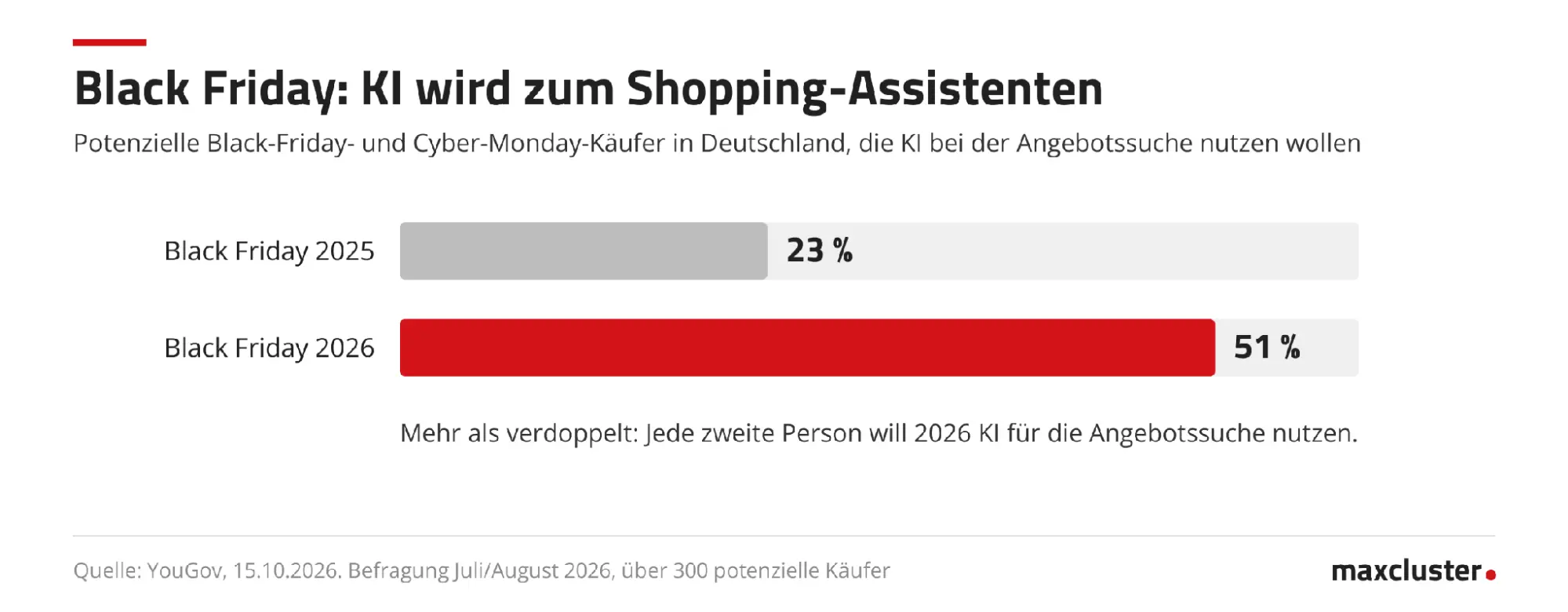
In Germany, 51 percent of potential Black Friday and Cyber Monday shoppers plan to use AI to find deals in 2026, up from 23 percent the previous year. 42 percent want to use it to find the lowest price, while 34 percent want to check whether discounts are genuine. AI tools have a trust rating of 66 percent, compared with 63 percent for customer reviews and online communities (source: YouGov, 2026).
For now, these figures reflect planned behavior. But a Deloitte study shows that AI is already an established part of shopping: 52 percent of consumers in Germany already use AI when shopping online, up from 44 percent nine months earlier (source: Deloitte via Lebensmittel Praxis, 2026). The US offers a glimpse of where things are heading: according to Adobe, traffic from AI services to retailers’ websites rose by 670 percent year over year on Cyber Monday 2025 (source: Adobe, 2025).
Practical tip: Review your product data. To help AI-powered search systems correctly identify your products, provide:
- clear model names and complete variant details,
- consistent information across your store and product feeds,
- prices and availability that match across all channels.
3. Individual sales events are becoming an extended season
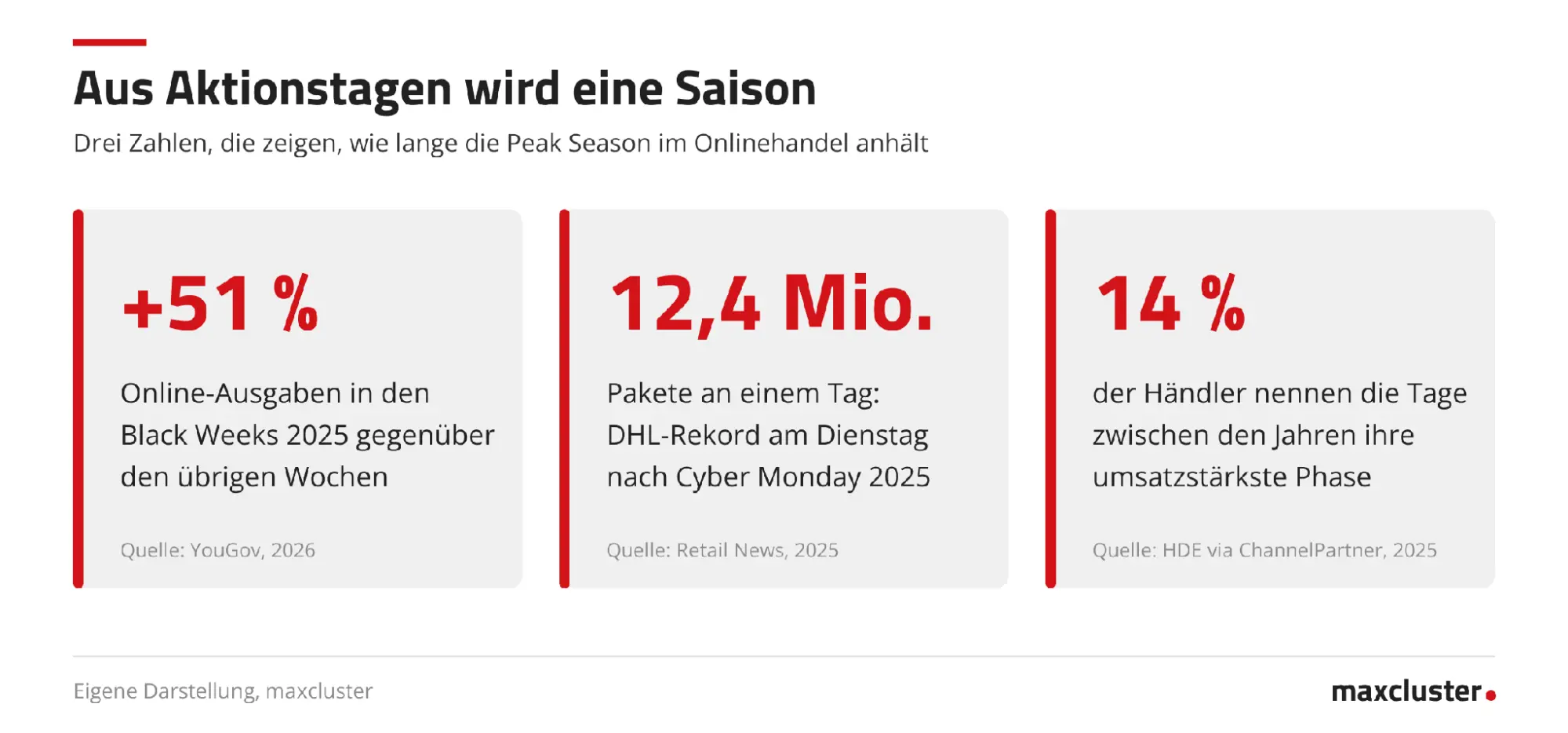
According to the YouGov Shopper Panel, online spending during Black Weeks 2025 was 51 percent higher than the average for the other weeks (source: YouGov, 2026). DHL did not record its highest parcel volume of 2025 until the Tuesday after Cyber Monday, with around 12.4 million parcels within 24 hours (source: Retail News, 2025).
What this means for you: Black Week is followed by gift shopping, last-minute orders and gift card redemptions. So expect several traffic spikes over roughly eight weeks, triggered by promotion launches or newsletters.
- Check that your hosting resources are sufficient for the entire period.
- Clarify in advance who can be contacted if performance issues arise.
4. Price is not the only factor when choosing a store
Discounts alone are not the deciding factor. In a 2025 Bitkom survey, online shoppers were more likely to rate payment options (54 percent), shipping and delivery (53 percent), and security and trust (51 percent) as very important than price and discounts (47 percent). In addition, 73 percent of respondents shop on their smartphones (source: Bitkom, 2025).
A good discount therefore has little value if the customer’s preferred payment method is unavailable or shipping costs only appear at the final step. In December, another question comes into play: will the gift arrive on time?
Your to-do list:
- Test the mobile checkout with different payment methods.
- Display shipping costs and delivery times before the final checkout step.
- In December, clearly communicate the order deadline for delivery before Christmas.
Get ready for peak season: 5 tips for your online store
More visitors do not automatically mean more orders. If your shop slows down under heavy load or the checkout does not work properly, potential sales are lost.
Imagine your newsletter goes out at 6 a.m. Within minutes, thousands of recipients land on the same promotional page, along with traffic from price comparison sites and other automated sources. During peak season, this happens not just once, but repeatedly.
1. Review your 2025 data
Start by looking at what happened in your shop during the last peak season, from Singles’ Day through the period between Christmas and New Year. These questions are particularly useful:
- Which promotional events and campaigns attracted the most visitors, and at what times of day?
- How did conversion rates and cart abandonment rates change?
- Were there complaints about loading times or checkout problems?
- Which promotions actually generated profitable orders?
Compare the results by device, payment method and campaign. This will show you where your shop is losing orders when traffic is high.
2. Plan promotions, inventory and technical requirements together
Decide early which promotional events you will take part in and which you will deliberately skip. Plan the start time, duration and channels for each promotion, and decide when newsletters, social media posts and ads will go live. Share this promotional calendar with your technical team so they can prepare for load spikes and check the server resources you need well in advance.
Think about inventory and margins too. What happens if an advertised item sells out during Black Week and is no longer available for Christmas shopping? Pausing an ad in time is better than running a campaign that leads to an unavailable product variant.
3. Test loading times and checkout under load
Many shop pages can be cached and delivered quickly. Carts, logins and checkout, however, are processed individually and cannot be served entirely from the cache. When many customers place orders at the same time, the load on the application and server increases.
Go through the entire purchase process on a smartphone. Test the tricky cases too: guest orders, combined discount codes, redeemed gift cards, failed payments and returning from the payment provider. Then check that the order appears correctly in both your shop system and your ERP system.
Application Performance Monitoring (APM) helps you identify which processes are slowing down your application, such as slow database queries or external integrations. You can find out more in the article “APM powered by Tideways. For tips on reducing loading times, see the article “Optimizing PageSpeed”.
4. Coordinate with your hosting partner early
Let your hosting partner know about your promotional calendar and expected traffic spikes well in advance. The start times of major sales promotions and newsletter send times are particularly important.
You do not always need more server resources. Sometimes, adjusting settings such as the number of PHP workers or the caching configuration is enough. If you are planning load tests, agree with your hosting partner beforehand on when they will take place, their scope and which environment will be tested.
Where possible, avoid major updates and new plugins around big promotional events and in the weeks leading up to Christmas. Schedule these changes before or after peak season.
To learn more about why reliable availability matters for online shops, read our article on high availability.
At maxcluster, we take much of this coordination work off your hands: our Seasons start as early as November 5, and we plan resources, settings and tests together with our customers. We explain exactly how this works below.
5. Clarify responsibilities
Decide who can be reached if technical problems arise and who makes decisions about the next steps, including on public holidays and between Christmas and New Year. Also clarify who is authorized to pause ads and how you will roll back to the last working version if an update fails. Document the key contacts and procedures so that, in an emergency, no one has to spend time figuring out who is responsible.
Seasons at maxcluster: How we help our customers get ready for peak season
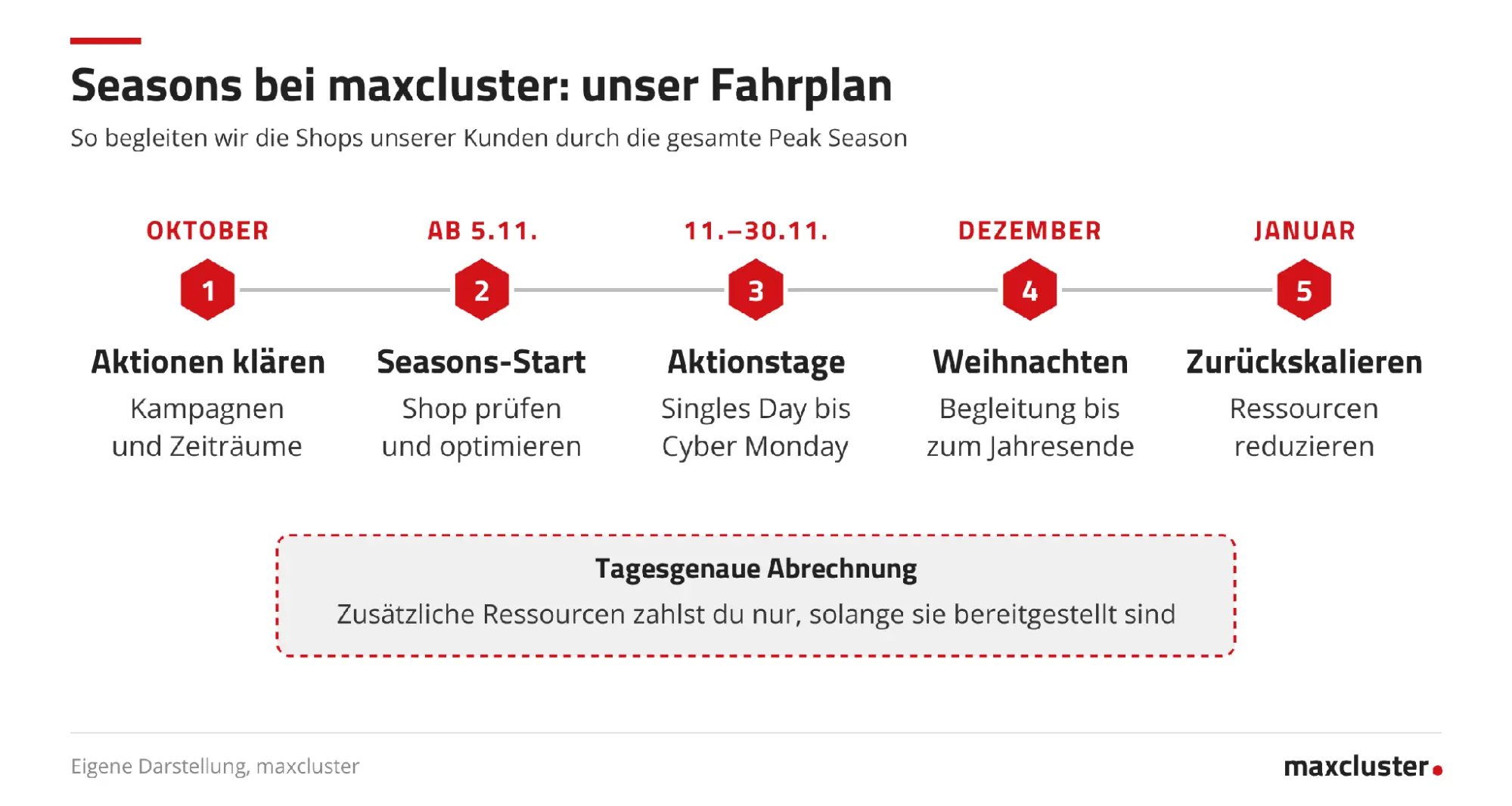
For us, peak season is not a single promotional day, but a period spanning several weeks. That is why our 2026 season starts on November 5, ahead of Singles Day, and runs into the new year.
As early as October, we talk to our customers about planned promotions and the expected traffic to their online shops. Last year, around 200 customers and their online shops took part. In 2026, we are supporting around 250 shops through peak season.
It is not about simply providing more server power across the board. We look at the campaigns being planned, review existing resources and use our ShopPerformance scans to identify potential bottlenecks. Having worked with the agencies and customers involved for years, we stay in close contact with everyone.
Depending on the findings, we adjust settings such as the number of PHP workers or provide additional capacity. This takes into account more than 40 parameters that affect shop performance.
After peak season, we work with our customers to review which additional resources are still needed. Capacity can usually be reduced again in January. This means our customers do not have to maintain higher server capacity permanently. With ourdaily billing, they only pay for additional resources for as long as they are provided.
The earlier we know about your promotions, the better we can plan the necessary adjustments and tests.
You can find more insights in our article “Peak Season 2025 in E-Commerce”.
Peak Season Checklist 2026
Before launching your first promotion, check that you have covered these points:
| Area | Checklist |
|---|---|
| Organisation | ☐ Promotion calendar set from Singles Day through the period between Christmas and New Year ☐ Newsletter and advertising schedules coordinated with the technical team ☐ Responsibilities and availability confirmed, including on public holidays ☐ Incident response and recovery plan created |
| Offers and communication | ☐ Prices, discounts and promotional terms checked ☐ Stock levels and margins checked, and handling of out-of-stock items agreed ☐ Product data in the shop and product feeds checked to ensure it is up to date ☐ Last order date for delivery before Christmas communicated |
| Technology and hosting | ☐ Hosting partner informed of the promotion calendar and expected traffic spikes ☐ Server resources and relevant settings reviewed ☐ Load tests completed for critical shop processes and results analysed ☐ Checkout, vouchers and payment methods tested on smartphones and desktops ☐ Major updates and new plugins scheduled for before or after the peak season ☐ Monitoring of shop performance and key order processes checked |
Conclusion
The 2026 peak season will bring several traffic spikes between Singles’ Day and the end of the year. Early preparation is key to helping your online store handle them smoothly: analyze your 2025 data, coordinate promotions, inventory and technical planning, test your checkout under load, consult your hosting partner early and clarify responsibilities, including holiday coverage. The checklist above will help you make sure nothing gets overlooked.
Planning major discount campaigns or expecting significantly more traffic? Let’s check together whether your hosting environment is ready.
FAQ: Frequently Asked Questions About the 2026 Peak Season
When is Black Friday 2026?
Black Friday is on Friday, November 27, 2026. Cyber Monday follows on Monday, November 30, 2026.
Which promotional events are part of peak season?
The main events are Singles’ Day (November 11), Black Friday (November 27), Cyber Monday (November 30), and the Christmas shopping season, extending into the period between Christmas and New Year. For niche shops, Halloween (October 31) is also relevant.
When should I start preparing?
Start several weeks before the first promotional event if possible—for most shops, that means October. This leaves enough time to coordinate campaigns with your technical team, test the checkout, and resolve any performance issues.
Should I run a load test before Black Friday?
Yes, if you are planning major promotions or expecting significantly more traffic. Focus your testing on areas that cannot be served from the cache: the shopping cart, login, and checkout. Agree with your hosting provider beforehand on when the test will take place, its scope, and which environment will be tested.
