
![[Translate to English:] Icon Chevron Right](/00-Media/Grafik/Icons/icon_chevron_right.svg)



- Kategorien:
- Categories:
- Performance
- Shopware
Management Summary
A large online shop in the healthcare sector planned the migration to Shopware 6—with millions of products, customers, and orders. As part of a pitch, load tests were carried out by the agency 8mylez, while maxcluster provided the highly available hosting infrastructure. The goal of the project was to find out how performant and scalable Shopware 6 can be operated under realistic enterprise conditions with millions of data records in a professional cluster setup.
Key results:
Shopware 6 is capable of running even very large shops with millions of items and orders with strong performance. The tests proved: With the right setup, even extreme load scenarios can be realistically replicated—reliably and with high performance.
- 99.99% availability with flexible scaling, even under peak load. Despite 230 million customer records and 160 million orders, the Shopware instance remained responsive and stable at all times.
- Up to 5,000 orders per hour and millions of items processed with strong performance.
- Up to 600,000 requests per hour were processed by the system.
Initial situation
A shop with exceptional requirements
Our Platinum partner 8mylez approached us with a special challenge: A prospective customer in the healthcare sector was planning to migrate a large online shop to Shopware 6
The challenge was not only an extremely high data volume —with millions of product, customer, and order records that must be processed reliably and with high performance—but also whether the entire technical infrastructure, including hosting, can reliably support these requirements
The key question was: Is Shopware 6, together with a modern, scalable hosting architecture, capable of meeting these requirements? And where are the technical limits of the system and the infrastructure when dealing with data volumes in the millions and heavy traffic?
To find out, 8mylez initiated a hands-on load test—focusing on high data load and intensive request load, for example to simulate customer orders with a later total volume in the millions while the system remains stable
As the preferred hosting partner for complex e-commerce environments, we supported 8mylez in this hands-on load test with a specially configured test cluster, our Shopware expertise and many years of experience hosting demanding platforms.
Benefits of maxcluster for agencies & shop operators
Highly scalable
Highly scalable cluster infrastructure for enterprise e-commerce—stable and high-performing even with millions of data records, tested under real-world conditions.
Faster & more efficient
Up to 5x faster provisioning of server setups compared to traditional hosting providers, thanks to preconfigured best practices.
High availability
99.99% availability included: high availability out of the box – with no hidden costs or complex SLA negotiations.
Everything integrated
Redis, Varnish, OpenSearch & RabbitMQ are included by default – no additional costs, no extra instances.
Preparations
Test cluster & performance optimizations
Cluster setup for Shopware
For the planned test scenario, we provided 8mylez with a modular cluster setup specifically tailored to the requirements of a data-intensive Shopware system
No chance of data loss and downtime
To ensure shops remain accessible even in critical moments—such as sudden load spikes caused by marketing campaigns, TV appearances, or seasonal peaks—maxcluster uses a fail-safe high-availability architecture in customer projects with an active and a passive server, redundant NVMe SSDs, and automatic fault detection—fully preconfigured and with no additional effort required from the agency or operator.
Identify performance issues before they occur
In real customer projects, shop operators and agencies also benefit from maxcluster’s proactive 24/7 monitoring: more than 80 system and application parameters are continuously monitored—supplemented by automated shop and web checks. This allows potential performance issues to be detected and resolved early, before they negatively impact the shopping experience
Hand over responsibility
The best part: maxcluster takes full responsibility for monitoring, relieving agencies and merchants. In critical situations, Shopware and Magento experts are on hand to provide advice and deliver fast, targeted support.
A future-proof cluster architecture that grows with you and your business
Building on this high-availability and operations foundation, the setup architecture for the test case was designed so that key tasks such as load balancing, caching, database access, and queue handling could be clearly separated and implemented as dedicated components.
A central load balancer routed requests via Varnish to multiple application servers, each equipped with the full Shopware codebase and all relevant configurations. The environment was further complemented by powerful services:
- Redis for session handling, caching, shopping carts, and locking
- RabbitMQ for queue management
- OpenSearch for high-performance, scalable search
- A primary/replica database setup to decouple and optimize read and write access
Shared data—such as media or generated assets—continued to be provided via a shared filesystem. The configuration followed Shopware best practices, such as the targeted use of Redis in multiple areas and Varnish as a full-page cache—including the necessary workarounds for known limitations in the xkey implementation.
The initial setup was carried out on a single application server. The setup was then distributed to additional servers via a deployment mechanism and data synchronization.
Integration of third-party software
In addition, an internal performance plugin from 8mylez (EmzPerformance) was used to further optimize the application layer in a targeted way. We supported the coordination of central cluster components—for example, the Redis setup for sessions—and ensured that the entire environment remains performant and stable even under high load. Targeted cache optimizations noticeably increased cache hit rates, leading to a significant improvement in speed and reliability—even under heavy load.
Performance optimizations
The basis was the official performance checklist from Shopware,, which 8mylez supplemented with additional measures based on its own experience. Since Shopware’s caching behavior in the default configuration does not work optimally under certain conditions, targeted adjustments were made to increase efficiency and improve robustness under load. To optimize the default caching, 8mylez used one of its three performance packages, which is specifically tailored to Shopware applications.
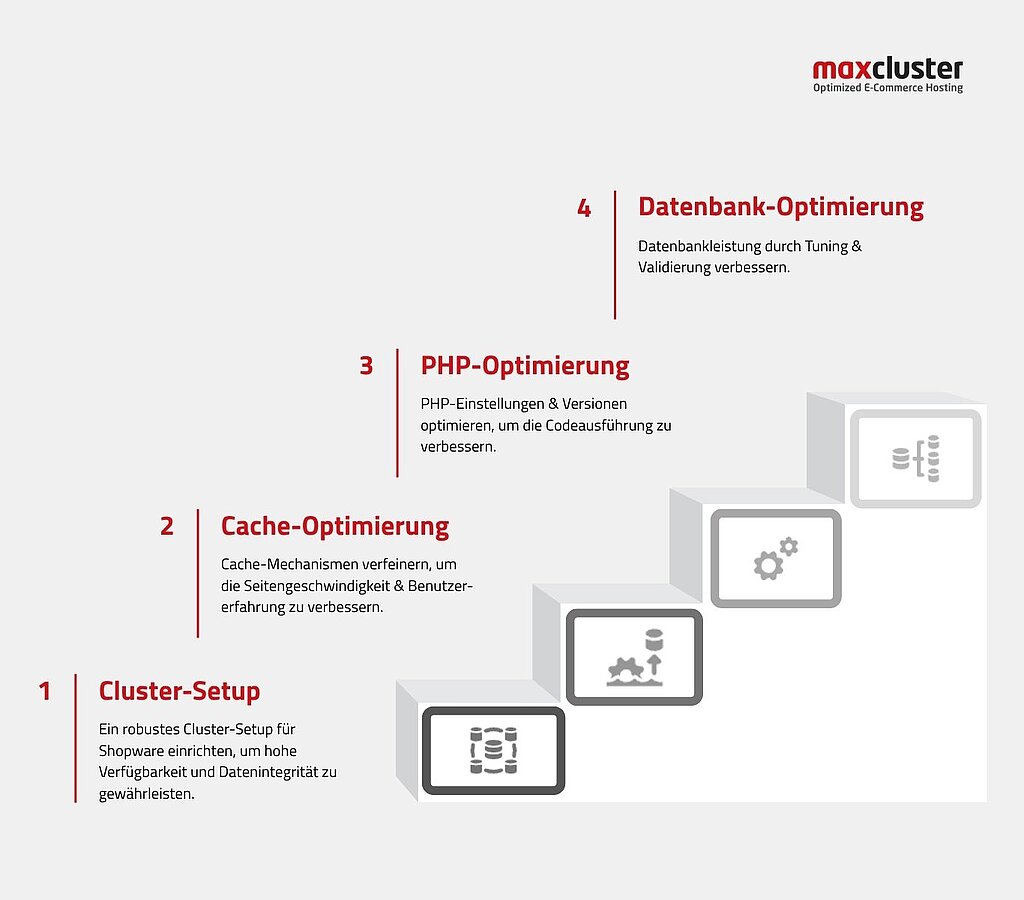
Cache optimizations in detail:
The goal was to deliver as many pages as possible directly from the cache to maximize performance and keep server load low even during high user activity. By default, the cache in Shopware is often bypassed—for example for logged-in users or filled shopping carts—which can negatively impact performance. The optimizations made addressed exactly this:
- Logged-in users also continue to benefit from caching, as a distinction is made between static and dynamic content.
- Customer-specific content (such as personalized prices or shopping carts) is loaded via Ajax or delivered using customer groups separated by cache.
- In addition, the cache invalidation logic was adjusted, as in the default behavior it often acts too aggressively and removes pages from the cache unnecessarily.
The result: Even under high load, the shop remained fast and responsive—while server load was significantly reduced at the same time.
PHP and database optimizations
In addition to the caching adjustments, we provided targeted tuning at the PHP and database level:
- Review and optimization of the PHP version in use as well as relevant PHP settings
- Fine-tuning of the PHP OPcache for more efficient code execution
- Optimization of the InnoDB buffer pool and validation of the MySQL version for high-performance processing of large data volumes
The result: significantly improved interaction between the application and the database—a key prerequisite for efficient processes as user numbers grow and shop structures become more complex.
Load Test Tool & Test Procedure
For the load tests, 8mylez used a custom-developed tool based on the Python framework Locust. As the hosting partner, we provided the necessary infrastructure and ensured a stable, high-performance environment for the intensive testing phases.
The test environment was dynamically scaled by maxcluster—resources such as CPU, RAM, and storage could be scaled live as needed—without any downtime or modifications. This made it possible to simulate load behavior realistically without being held back by static limits.
The tests were carried out in stages with constant traffic—up to 600,000 requests and 5,000 orders per hour were processed. The focus was on backend performance and the underlying server processes. Frontend resources such as images, JavaScript, or CSS were deliberately excluded, as they typically do not cause bottlenecks in such tests.
The load-testing tool used was developed based on an open-source project by Tideways and extended with specific Locust logic for Shopware. Since the standard version did not meet the requirements, 8mylez optimized the tool specifically for the Shopware context.
It enables fine-grained configuration of parameters such as user types, number of visitors, scenarios, and their weighting. In the tests conducted, 125 concurrent visitors were simulated over a period of one hour. The focus was on realistic customer traffic—API imports were not part of the test series, but could easily be added.
Test phases and process
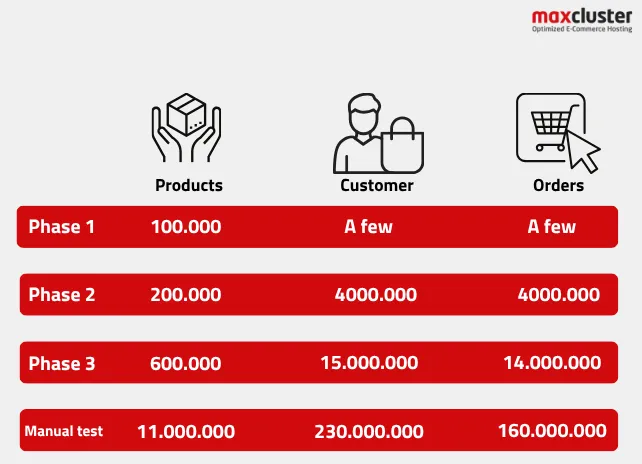
The load tests were carried out on a dedicated test cluster provided by us, in three clearly defined phases:
- Phase 1: First, a Shopware instance was set up without any data. This was followed by the import of 100,000 products as well as initial customer and order data.
- Phase 2: The number of products was increased to approx. 200,000 products doubled, supplemented by 4,000,000 customer and order records each.
- Phase 3: The test data was further expanded to 600,000 products, 15,000,000 customers and 14,000,000 orders.
In all three phases, the system remained consistently stable and performant.
In addition, manual tests were conducted with a significantly expanded data set – with up to 11,000,000 products, 230,000,000 customers and 160,000,000 orders. Even under this massive data load, the Shopware instance remained stable.
The main goal was to ensure that the shop remains reliably accessible and performant despite extremely large volumes of data. Particular attention was paid to server response times, especially Time To First Byte (TTFB)* – both on average and at the 95th percentile.
Although 8mylez had not defined any fixed thresholds, measurements were systematically taken to determine how many requests and orders per second could be processed over a one-hour period without any noticeable drop in performance.
*The time until the server sends the first data packet.
Results
Stable performance under high traffic and large data volumes
The load tests carried out by 8mylez on our test cluster clearly show: Performance remained consistently stable even under heavy load. During the one-hour tests, the number of requests and orders per second remained stable—just like the server response times.
The average TTFB was around 0.8 seconds, the 95th percentile at around 3.6 seconds —even under heavy data load and high user activity. Note: These values were measured at full utilization and on a highly data-driven setup—under normal operation they would be significantly lower.
Key findings from the tests
- The maximum number of simultaneous requests and orders per second depends directly on the resources available in the cluster.
- maxcluster’s hosting infrastructure proved to be powerful, stable, and flexibly scalable.
- Close coordination with the 8mylez team enabled fast and efficient implementation of the setup—including targeted technical advice on configuration and performance optimization.
- Shopware 6 provides a solid foundation for horizontal scaling: additional app servers can be integrated easily as traffic grows.
Interim conclusion
Large data volumes are not a challenge for Shopware 6 in an optimized environment. Even with over 200 million records, there was no performance degradation—neither when registering new customers nor when placing orders.
Challenges & Solution Approaches
Where Shopware reaches its limits – and what can still be improved on the infrastructure side
As part of the load tests, it became clear: the key challenges lie less in Shopware itself and more often arise from technological limitations of adjacent systems—especially when very large volumes of data have to be processed
Our partner 8mylez has identified the following problem areas for which individual technical solution approaches will need to be found in the future.
- Product indexing with Elasticsearch: As the amount of data grows, the indexing process takes increasingly more time and becomes a bottleneck with very large product catalogs.
- Performance in the admin area: Shopware’s standard admin interface reaches its limits when managing large volumes of data. While plugins exist to extend it, they are often not designed for use in complex enterprise setups.
- Migrations & updates: System and database migrations become more technically demanding with large volumes of data. Strategically planned processes are needed to implement updates in a performant, low-risk way.
- Statistics & reporting: Shopware’s standard reports access large data sets directly, which leads to noticeable delays with millions of records. Potential solutions could include integrating Elasticsearch or using specialized reporting tools.
- Caching & Varnish: Under heavy load, problems can occur if cached requests are not forwarded correctly to the app servers. Particular caution is required here, especially with Varnish configurations.
The role of hosting in addressing such challenges
These technical challenges show how crucial the right hosting infrastructure is to the success of complex Shopware projects. maxcluster’s scalable, highly available hosting architecture makes it possible to address these limitations in connected systems in a targeted way.
By using modern technologies such as optimized caching, high-performance databases, and a cluster setup tailored specifically to Shopware, we support a stable, high-performing system landscape. This ensures smooth performance even with large data volumes and peak loads—and, thanks to our many years of Shopware experience, we provide the best possible support to agencies like 8mylez to take their projects to the next level.
Support and expertise for agencies
maxcluster empowers agencies with its extensive expertise and hands-on consulting, enabling them not only to respond quickly to technical challenges but also to optimize their projects efficiently and independently. This comprehensive knowledge is a key factor that helps our partners reach their goals faster and more successfully.
Our hosting solution was deliberately designed so that agencies like 8mylez can act quickly and efficiently. This means bottlenecks are identified and resolved early—without the delays that often occur with complex or poorly prepared setups.
Fast setup and best practices
Although this project is a practical test case, our many years of experience with customer projects and our exchange with partners show that setting up a comparable setup with other hosting providers often takes significantly longer.
With maxcluster, server configurations are ready within minutes because the components are optimally coordinated and proven processes are used. This means projects are ready to go up to 80% faster than with other providers such as Hetzner or platform.sh. This saves valuable time and resources that can be invested in the actual development and optimization of the shop.

99.99% availability is not a given
For the medical shop, revenue reliability and brand reputation were extremely important, so 8mylez opted for a high-availability system. maxcluster provides this high availability “out of the box” – compared to other hosts like Hetzner or platform.sh, without major SLA surcharges. This ensures that our customers can rely on a stable platform that remains available at all times, even in critical situations.
Conclusion
Scalability and performance successfully proven
The load tests carried out by 8mylez on the test cluster we provided show impressively: Shopware 6 remains stable, powerful, and flexibly scalable even under heavy load. Even with massive traffic and large volumes of data, the platform stayed reliable and performant.
This was made possible by the perfect interaction with our specialized hosting infrastructure, which delivers modern technologies and best practices out of the box, creating the foundation for consistently stable performance.
Our key findings at a glance:
1. High scalability under load
Even at 5,000 orders per hour and sustained traffic with up to 125 concurrent visitors, there were no performance drops. The modular cluster setup proved to be flexibly expandable—a major advantage, especially during seasonal peak loads such as Black Friday.
2. Efficient handling of large volumes of data
In the tests, Shopware 6 processed several million records without any issues, including up to 600,000 products and 15 million orders. Through the targeted use of Elasticsearch and optimized caching strategies, consistently high performance could be ensured even for complex search queries and large catalogs.
Shopware 6 is therefore suitable not only for classic shop projects, but also for large, data-intensive e-commerce initiatives with high traffic. Combined with our scalable hosting architecture, the platform provides a robust foundation for future-proof, high-performance online retail.
3. Technical architecture as a success factor
The architecture of the cluster used—consisting of specialized components for load balancing, caching (Redis), queue handling (RabbitMQ), high-performance data access via OpenSearch, and a primary/replica database setup—was largely responsible for the results achieved.
The tests clearly demonstrate: With a technically mature infrastructure, Shopware 6 can be successfully scaled even for extensive, high-growth projects.
A particular advantage was the high flexibility in server configuration. Services such as Redis, Varnish, Elasticsearch, or OpenSearch are already included free of charge with maxcluster. This meant bottlenecks could be compensated quickly and a smooth test setup ensured.
We are pleased that we were able to support 8mylez as a hosting partner for this demanding test project—with a high-performance test cluster and targeted technical consulting.
About 8mylez
Our Platinum Partner 8mylez is one of the leading agencies in the Shopware ecosystem, with around 40 specialized developers. Since 2015, the team has delivered sophisticated e-commerce projects—focused on high-performance code, custom designs, and maximum performance. Their mission: every Shopware shop should not only impress technically, but also provide a first-class user experience.