![[Translate to English:] Icon Chevron Right](/00-Media/Grafik/Icons/icon_chevron_right.svg)





Forget revenue! How to maximize profit with Google Ads & more
- Kategorien:
- Categories:
- Guest article
- Marketing
Thinking of performance marketing as a profit center
Traditionally, marketing budgets are treated as a lump sum - expenses whose impact seems hard to quantify. Profit-Driven Marketing flips this mindset: performance marketing becomes a profit center by tying it directly to profit goals. In other words, activities are managed to deliver an immediately measurable contribution margin. Every campaign is asked: how much profit does it create? Instead of counting clicks or revenue, the focus shifts to profit per euro of ad spend.
Shifting the perspective from cost center to profit center requires rethinking how we measure marketing success. The key is using financial metrics that go beyond revenue. In particular, profit metrics such as gross margin or, even better, gross profit per sale are relevant. They show what truly remains after all directly attributable costs. Once these figures are known, performance marketing can be steered more precisely: campaigns, ad groups, and products can be prioritized or scaled back based on their profit contribution.
Why rely on profit metrics instead of revenue alone?
The reasons are obvious: revenue is not profit. You can generate high revenue with expensive campaigns that are unprofitable due to low margins or high costs. Focusing only on revenue risks losing sight of unit economics. A revenue-only optimization (classic ROAS) often pushes budget toward high-revenue products - not necessarily the most profitable ones. The result: you may burn money on sales that yield little profit, while high-margin offerings remain underfunded.
Focusing on profitability, by contrast, enables differentiated ad allocation with a clear focus on returns: more budget flows into high-margin products and campaigns, while revenue-heavy but low-margin areas are identified and optimized, throttled, or avoided.
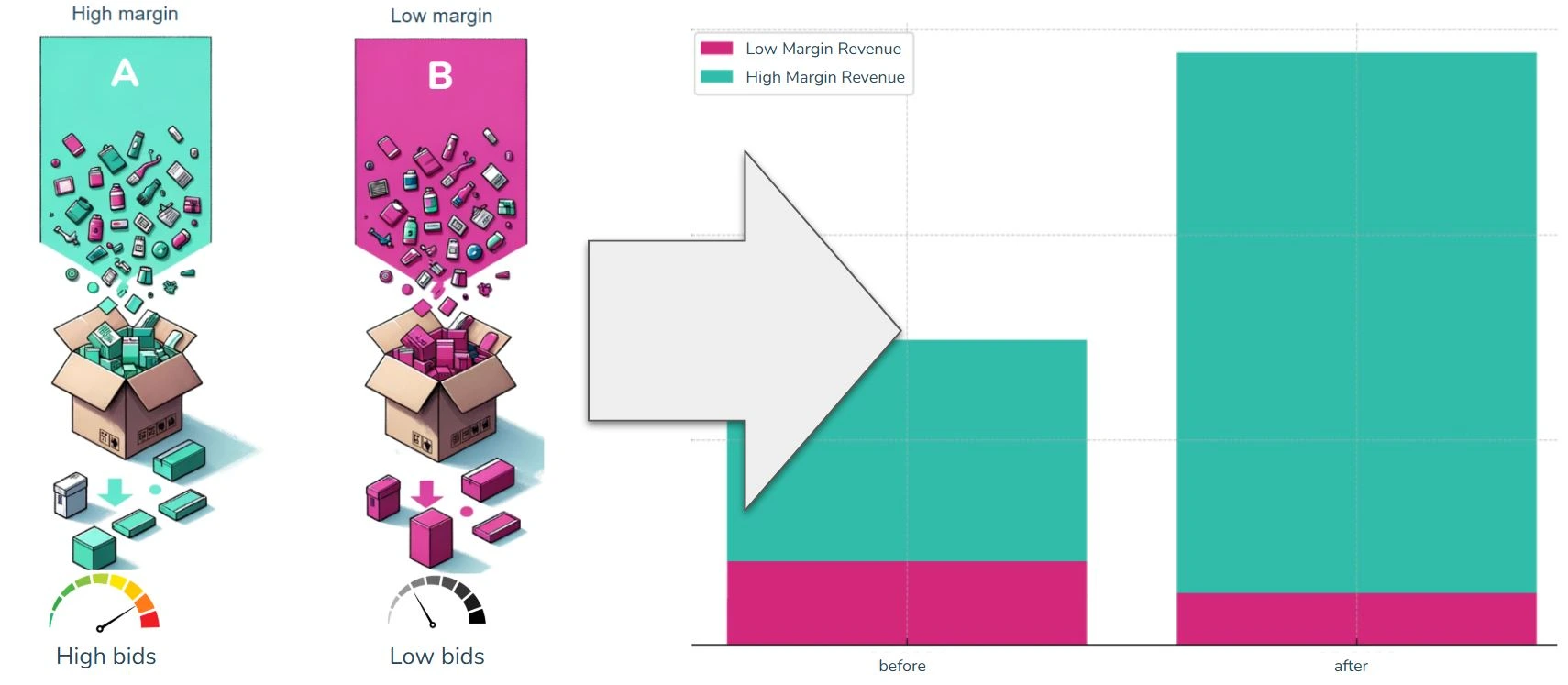
Profit Driven Performance Marketing Example. Source: squadt
This differentiation ultimately reduces scaling risk, because budget is deployed far more precisely. In short, profit-oriented metrics offer:
- More realistic success measurement: revenue ≠ profit - only a profit view shows whether a campaign truly pays off.
- Targeted budget control: spend can be concentrated on the most profitable campaigns and products instead of tying up resources in flashy but unprofitable revenue.
- Assortment transparency: profit metrics distinguish true high-margin bestsellers from mere revenue drivers with low margin. Marketing can fully leverage strengths in high-margin product and service segments.
- Long-term profitability: it is no longer "revenue at any price" but sustainable growth. Marketing investments contribute to profit goals and secure long-term viability.
POAS instead of ROAS: measuring profitability with Profit on Ad Spend
ROAS (Return on Ad Spend) has been the standard performance metric. ROAS is the revenue attributed to advertising relative to ad costs. Put simply: ROAS = revenue / ad spend. It shows how much revenue a campaign brings but not how much profit remains. A high ROAS can suggest success, yet if margins are thin or product costs are high, a campaign can still lose money.
The better metric for Profit-Driven Marketing is POAS (Profit on Ad Spend). POAS looks at profit per euro of ad spend. The formula is simple:
Profit on Ad Spend (POAS) = (Profit / Ad Spend) × 100%
Profit equals revenue minus all incurred costs (primarily product costs such as purchase/manufacturing, plus shipping and fees where relevant).
Example: A campaign generates €10,000 in revenue at €7,000 cost of goods, leaving €3,000 profit. With €2,000 ad spend, POAS = 3,000 / 2,000 = 1.5 (150%). This means every euro invested produced €1.50 profit. POAS > 1 (or > 100%) indicates a profitable campaign, while POAS < 1 indicates a loss. By contrast, ROAS in this example would be 5 (€10,000/€2,000) - a number that sounds strong but does not distinguish profitable from unprofitable revenue.
What is particularly exciting is the ability to train Smart Bidding - the bidding strategies of platforms like Google Ads and Meta - on POAS goals. Campaign types such as Google Performance Max or Advantage+ Shopping can then be used fully automatically to maximize profit. To do this, the achieved profit must be passed directly to the ad platforms as the conversion value. Ideally, this data transfer is server-side or at least obfuscated in a client-side setup so competitors cannot infer your margin situation. Implementing this is more technically demanding and not always feasible without external help.
Practical steps to Profit-Driven Marketing
Where do you start? First, get a clear view of gross margins at the product level. This is usually straightforward, as purchase price or manufacturing cost typically exists per SKU in your ERP. Subtract cost of goods sold (COGS) from net sales price to get gross margin. Knowing these spreads alone supports better decisions: high-margin product and service segments can be prioritized, while low-margin segments are moved into campaigns with stricter cost control.
Whatever actions you derive from your margin picture, the next step is to establish regular measurement of results. For example, regularly calculate profit for a given period and compare it to ad costs. If you already have a BI solution, consolidate the data at that layer and analyze across channels. If you do not but still want campaign-level analysis, there is at least a low-barrier option in the Google ecosystem: you can track gross profit development directly at campaign level by sending the mentioned cost of goods sold (COGS) as a product-level attribute within the product data feed.
Conclusion
Profit-driven marketing turns your marketing budget from a cost center into a profit engine. By consistently focusing on gross profit, you are investing in real returns. This reduces risk, sharpens scaling, and directs your budget to where your product range is truly strong. But performance marketing can only reach its full potential when systems and data flows function smoothly. The technical basis for this is provided by a powerful hosting infrastructure – such as that from maxcluster, which ensures maximum performance, high availability, and fast data processing.
Autor

As the chief operating officer of squadt, an e-commerce marketing agency, Alexander Mathiesen brings deep insights into the challenges of e-commerce. In light of increasing margin pressure, he and his team develop practical strategies that measurably improve results.
Company
squadt is the e-commerce marketing agency for sustainable growth. squadt supports online retailers and manufacturers from strategy to implementation—data-driven, cross-channel, and with a team of consultants, SEO, content marketing, SEA, paid social, analytics, and UX/UI design experts.