![[Translate to English:] Icon Chevron Right](/00-Media/Grafik/Icons/icon_chevron_right.svg)





TCO in E-Commerce: Why the Project Price Is Only the Beginning
- Kategorien:
- Categories:
- Performance
- Magento
- Shopware
TL;DR
Project proposals usually provide a clear breakdown of implementation, licensing, and hosting costs. Less visible are the expenses that arise only after go-live, such as maintenance, further development, performance optimization, and potential downtime. Over several years, these cost factors account for a significant share of the Total Cost of Ownership.
When receiving a proposal for a new online shop, the project costs are usually easy to understand. Implementation, licensing, and hosting are clearly calculated and can be compared without difficulty. What is much harder to assess, however, is how much the shop will actually cost after go-live.
This is because a significant share of the Total Cost of Ownership only begins to emerge during ongoing operations. A Magento shop is often used for five to seven years before a major modernization or replatforming becomes necessary. During this time, costs arise for maintenance, further development, and technical operations, many of which are only partially reflected in the original project calculation.
A complete TCO assessment should therefore not end at go-live. It should also include the cost categories that accompany the shop over several years, as well as the questions that can help identify potential cost drivers more accurately before the project even begins.
Why the Project Price Covers Only Part of the Costs
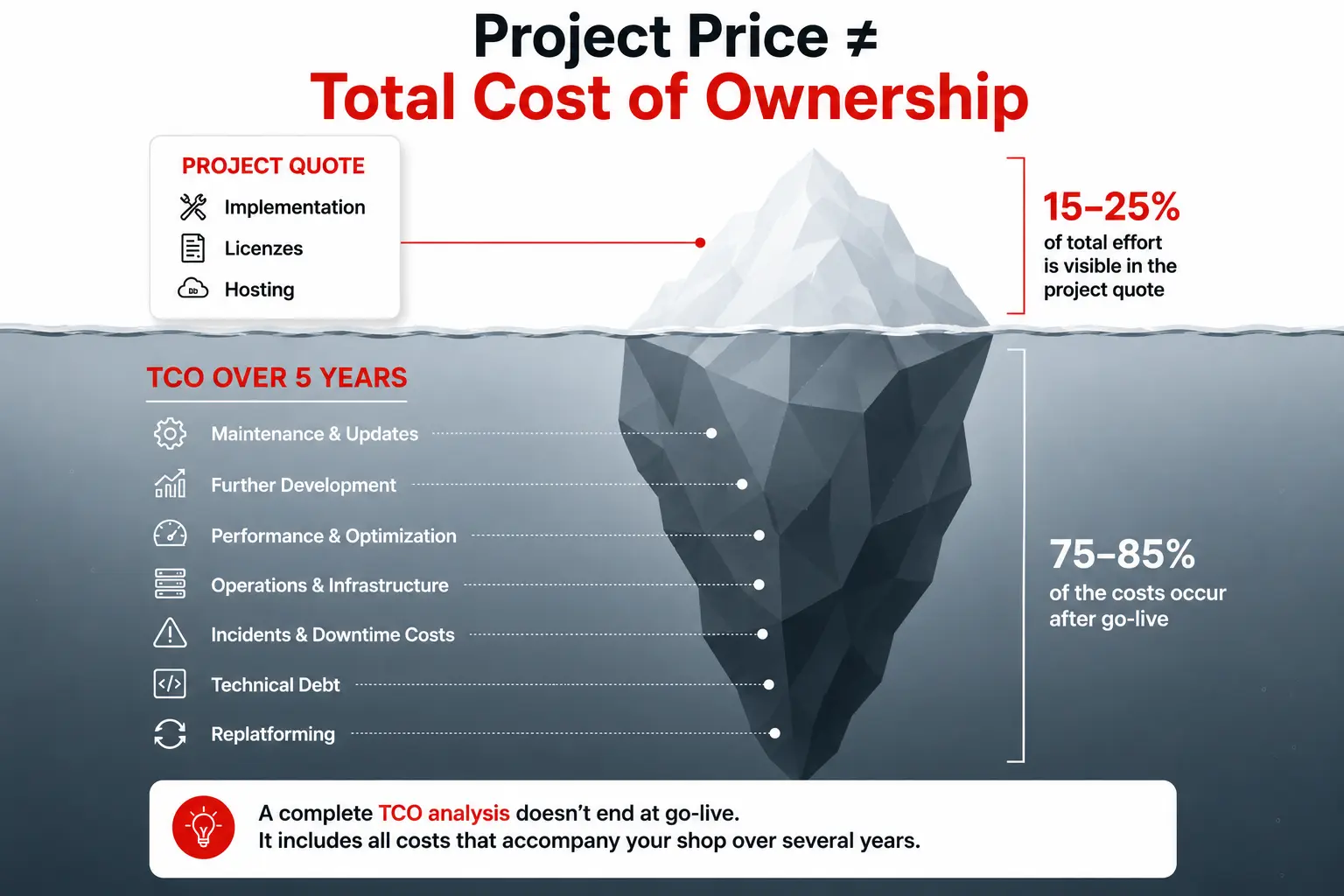
The project price primarily covers the costs incurred up to go-live. A significant share of the total cost, however, only arises during ongoing operations and continues to accumulate over the following years.
For this reason, it makes sense to distinguish between one-time and recurring expenses when calculating the overall cost. Implementation and migration efforts can usually be planned quite reliably at the beginning of the project. Design and testing are also typically listed clearly in the project proposal. More difficult to estimate are the costs that become relevant only after go-live. These include licensing, hosting, and maintenance, as well as the continuous development required to keep the shop competitive. In many cases, these ongoing expenses are only partially reflected in the initial project calculation.
Based on our project experience, implementation and licensing often account for only around 15–25% of the Total Cost of Ownership over a five-year period. The exact proportion depends on the individual setup and its complexity. The following example illustrates the scale that the remaining costs can reach.
Example Scenario: The 5-Year TCO of a Mid-Sized Fashion E-Commerce Store
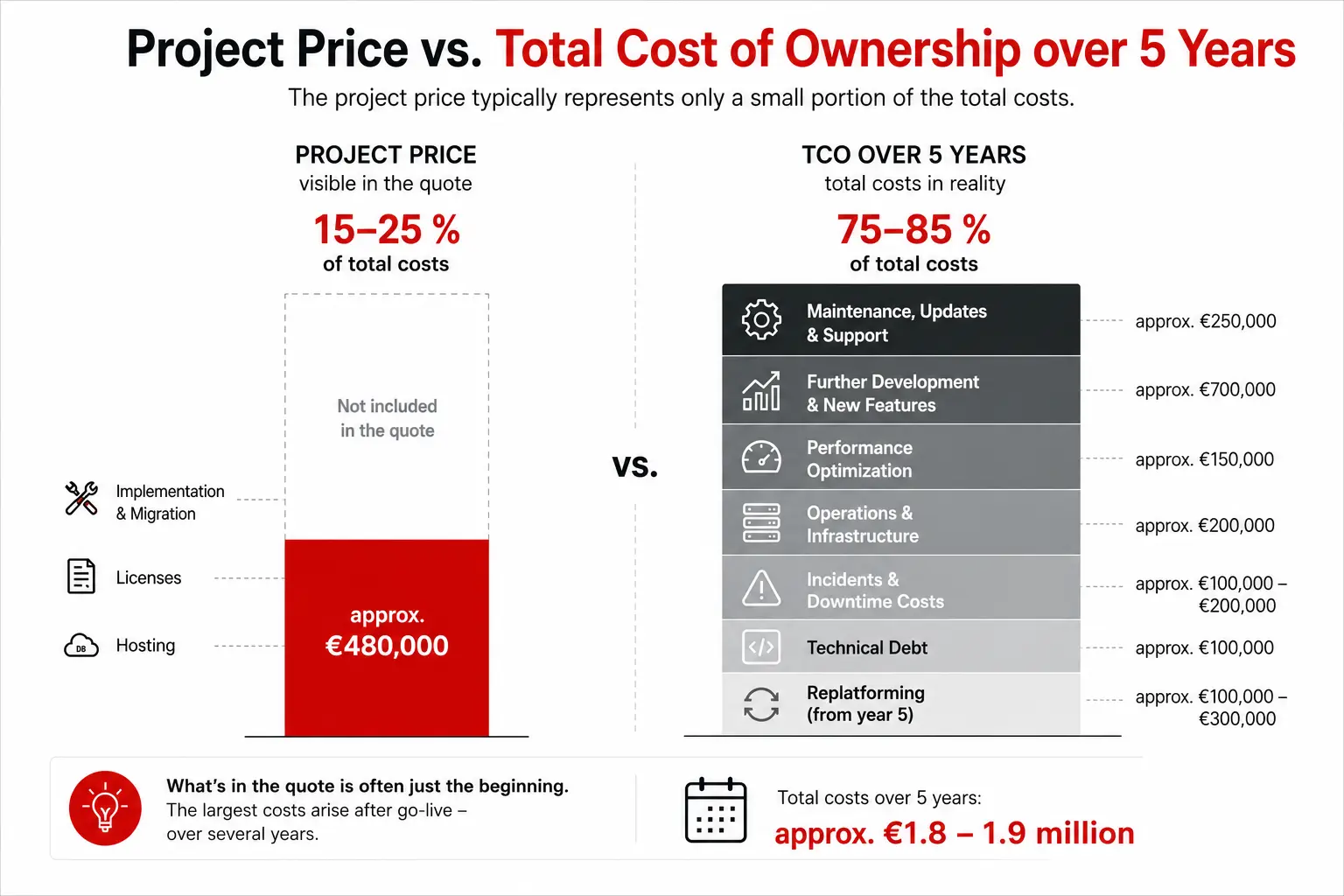
A mid-sized fashion retailer generating approximately €20 million in annual revenue launches a Magento-based online shop. The original project budget includes implementation, licensing, and hosting. Over a five-year period, these items amount to approximately €480,000 in total.
However, the costs that arise during ongoing operations are not fully accounted for. These include shop maintenance and continuous development, as well as regular performance optimization. If the shop experiences prolonged downtime during a high-revenue period or later requires replatforming, the total cost increases significantly.
| Category | 5-Year Total |
|---|---|
| Implementation, Licensing, Hosting (included in the project proposal) | approx. €480,000 |
| Maintenance, Continuous Development, Performance Optimization | approx. €950,000 |
| Peak-Season Downtime and Later Replatforming | approx. €340,000–490,000 |
| Total Cost Over Five Years | approx. €1.8–1.9 million |
In this example, the original project budget accounts for only about one quarter of the actual Total Cost of Ownership. While the figures are illustrative, they reflect a common pattern: as technical complexity increases over time, so do the costs of operations, continuous development, and future adaptations.
Ten Cost Categories Instead of Three
A complete TCO assessment goes far beyond the cost items listed in the original project proposal. While implementation and licensing are usually covered in full, hosting costs are often only partially included. Maintenance and continuous development tend to be underestimated, and many of the costs that arise only during ongoing operations are typically not included in the proposal at all.
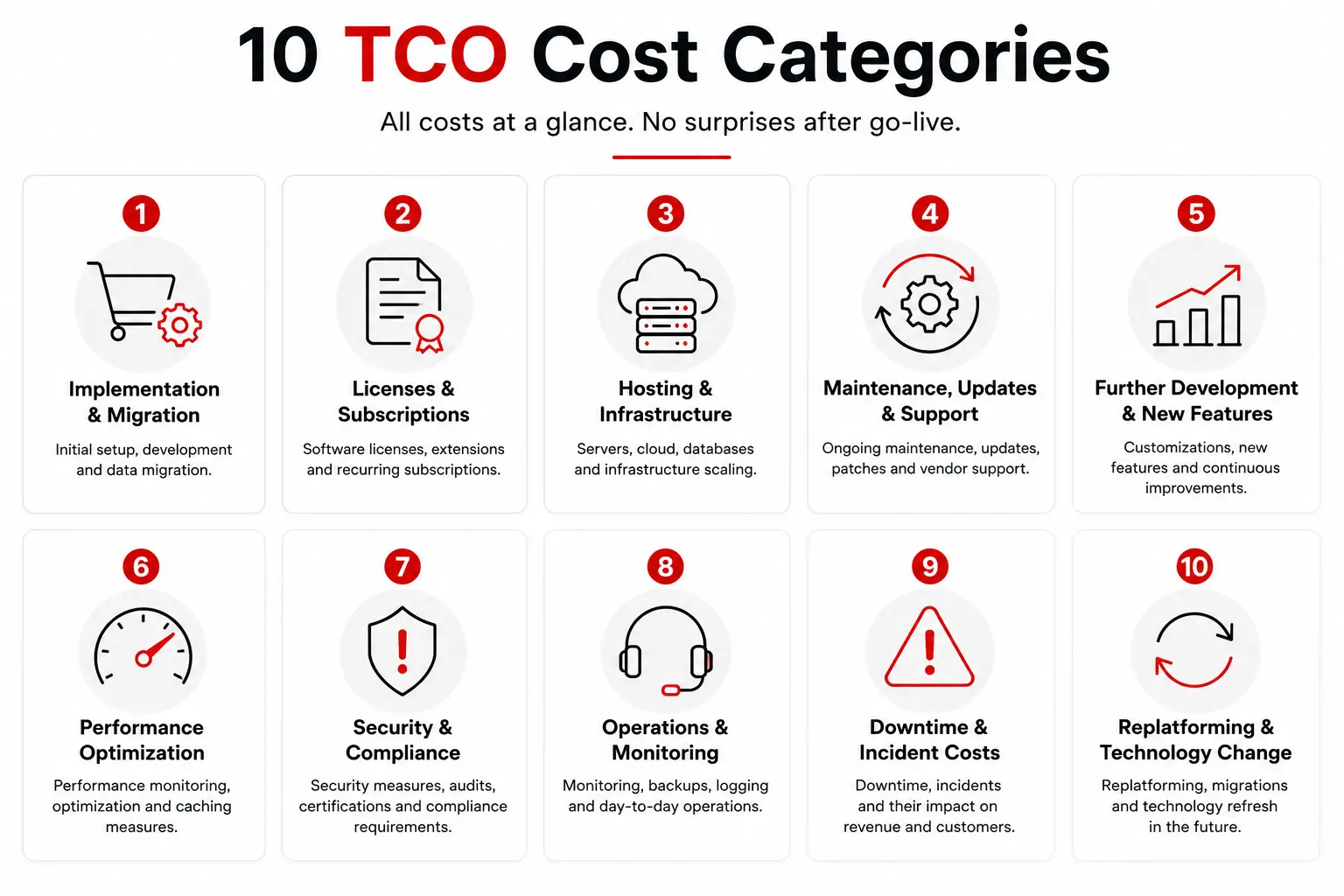
| Cost Category | Share of 5-Year TCO | Included in the Project Proposal? |
|---|---|---|
| Implementation & Migration | 10–15 % | Yes |
| Licensing & SaaS Costs | 5–10 % | Yes |
| Hosting & Infrastructure | 8–15 % | Partially |
| Maintenance & Updates | 10–15 % | Rarely in Full |
| Continuous Development | 25–40 % | Rarely |
| Operational Complexity | 5–10 % | No |
| Performance-Related Costs | 3–8 % | No |
| Incident & Downtime Costs | 2–10 % | No |
| Technical Debt | 5–10 % | No |
| Migration Pressure (from Year 5) | 10–20 % | No |
The ranges shown are intended as guidance and are based on different shop setups. They do not represent a fixed cost distribution and therefore cannot simply be added up to 100 percent.
One of the biggest cost drivers is continuous development. New features, additional integrations, or expansion into new markets often cost more over several years than the initial implementation itself. Yet these ongoing efforts are frequently only partially reflected in the original project proposal.
Technical debt can also become expensive over time. During day-to-day operations, it often remains unnoticed. Its impact usually becomes apparent during major updates, when outdated dependencies or customizations require additional development effort.
The same applies to replatforming. If an online shop becomes increasingly difficult to maintain or extend, rebuilding it from the ground up may be more cost-effective than continuing with individual modifications. The cost of such a project depends largely on the condition of the existing architecture.
Many of these expenses are not visible in the original project proposal. Over the course of several years, however, they can account for a substantial share of the Total Cost of Ownership. This also includes indirect costs resulting from inefficient processes or delayed development.
Downtime is another significant risk factor. According to a study by Splunk and Oxford Economics, large organizations lose around 9% of their annual profit due to downtime when indirect impacts are taken into account (Source: Splunk/Oxford Economics, 2024).
Why the Incomplete Cost Calculation Persists
Although traditional project calculations fail to capture many of the costs that arise later, they are still widely used in practice. One reason is that the necessary information is spread across different sources. Project costs are listed directly in the proposal, while ongoing expenses usually have to be gathered from several budgets and areas of responsibility. As a result, comparisons often focus only on the figures that are immediately available.
Another factor is that decisions are rarely evaluated over a period of five years or more. The person selecting a platform or provider today may no longer be responsible for its ongoing operation several years later. The long-term consequences therefore often play only a limited role in the original calculation.
Separate budgets also make it more difficult to gain a complete picture. Project costs are often planned independently from the expenses associated with operations and continuous development. As a result, not everyone who could realistically assess the future costs is necessarily involved in the decision-making process.
This is not the fault of individual stakeholders, but rather a consequence of common planning processes. In many cases, the financial assessment ends at go-live, even though a large share of the costs only begins to arise afterwards. A TCO analysis therefore also takes into account operations, continuous development, and potential risks over the following five to seven years.
Why TCO Is an Architectural Decision
Many of the decisions that influence the Total Cost of Ownership are made at the very beginning of a project. These include the frontend architecture, the hosting model, and the integration of external systems. Together, they determine how easily an online shop can be maintained, extended, and operated reliably over the years.
A high-performance frontend alone is not enough. To deliver its full benefits in day-to-day operations, the hosting environment and technical processes must be aligned with it. At the same time, an unsuitable frontend architecture cannot be compensated for indefinitely by adding more infrastructure.
For this reason, TCO should already be considered before selecting a platform or technology partner. To learn which factors have the greatest impact on long-term operating costs, read our article "TCO Drivers in E-Commerce: What Makes an Online Shop Expensive in the Long Run." It explores the effects of growing technical complexity, declining performance, and operational disruptions.
The First TCO Check: Four Questions
The following four questions can help identify potential gaps in a project proposal at an early stage:
- What are the expected annual operating costs when maintenance and continuous development are realistically taken into account?
- Which services are not included in the project proposal, such as monitoring, incident handling, or regular performance optimization?
- How will costs change if traffic, order volume, or system requirements increase significantly?
- What response times apply in the event of incidents, and who is responsible for resolving them?
Not every question needs to be answered in detail from the outset. The key is to identify where assumptions are missing or responsibilities have not yet been clearly defined. These are often the areas where additional costs arise during ongoing operations.
Conclusion
The project price reflects only part of the actual cost. A significant share arises after go-live, once maintenance, continuous development, and ongoing operations over several years are taken into account.
A TCO assessment provides greater transparency. It makes project proposals easier to compare realistically and helps identify at an early stage which decisions could lead to additional costs later on.
Calculate Your TCO
Use the maxcluster TCO Calculator to compare the long-term Total Cost of Ownership of Shopify Plus and Magento with Hyvä. It considers not only the initial project costs but also the expenses that arise during ongoing operations.
The calculation is based on publicly available sources, industry benchmarks, and maxcluster’s operational experience. It is intended as a guideline and does not replace an individual business case analysis.
Try the TCO Calculator: https://maxcluster.de/tco-shopify-plus-und-magento-hyva
FAQ
What Does the TCO of an Online Shop Include?
The Total Cost of Ownership includes all costs incurred throughout the entire lifecycle of an online shop. These include implementation and licensing, hosting, maintenance and updates, continuous development, operational complexity, performance-related costs, incident and downtime costs, technical debt, and future replatforming.
What Is a Suitable Timeframe for a TCO Assessment?
A period of five to seven years is generally appropriate. A Magento shop is often operated for this length of time before a major modernization or replatforming becomes necessary. Only over this period does the actual development of ongoing costs become clear.
Why Is the Project Price Not Enough?
The project price mainly reflects the one-time costs incurred up to go-live. Based on our project experience, implementation and licensing often account for only 15–25% of the total cost over five years.
Which Costs Are Most Often Overlooked?
The costs most frequently overlooked include continuous development, operational complexity, performance-related costs, incident and downtime costs, technical debt, and future replatforming. These items are often not included in project proposals at all or are only partially covered.
When Should TCO Be Calculated?
Ideally, before selecting a platform and provider. Many of the factors that influence future operating costs are determined at the very beginning of a project.