![[Translate to English:] Icon Chevron Right](/00-Media/Grafik/Icons/icon_chevron_right.svg)





Technical SEO for online shops: Why hosting performance and infrastructure are essential
- Kategorien:
- Categories:
- Performance
- Guest article
- Marketing
Your online shop is up and running. The products are high-quality, the content is well structured, and the product and category texts are search engine optimized. Nevertheless, the rankings fall short of expectations. The consequences are noticeable: lower organic visibility, less-qualified traffic, and declining conversions.
A common reason for this is not the content, but the technology. High TTFBvalues (Time To First Byte, i.e., the time until the first server response), timeouts, or unstable availability mean that Google crawls pages less frequently and indexing becomes inefficient. Rankings lose stability. At the same time, users lose confidence—no one likes to wait for pages that load slowly or are temporarily unavailable.
You can think of it like a brick-and-mortar store: if the door is regularly blocked or sticks when opening, fewer customers will come in – no matter how good the product range is.
Professional hosting as the basis for technical SEO in your shop
In e-commerce in particular, technical SEO is no longer an add-on, but a basic requirement. Hosting and infrastructure form the foundation for ensuring that your shop remains reliably accessible, fast, and stable—even under heavy load.
This is especially true for medium-sized and large shops with many indexable pages, filter combinations, and product variants. The more complex the shop, the greater the impact of the technical basis on crawling, indexing, and performance.
In the following, we will take a look at which technical factors are decisive – and what concrete benefits optimizations bring.
What does technical SEO involve—and why is it worth the effort?
Google no longer evaluates websites based solely on content. Technical quality and user experience also directly influence rankings. Content can only be visible if it is fast, stable, and permanently accessible.
The central components of technical SEO in online shops include:
- Indexability
This determines which pages end up in the Google index. It is controlled via robots.txt, noindex instructions, and canonical tags. - Crawl efficiency
Every domain has a limited crawl budget. The goal is to guide Google to the important pages and exclude unnecessary URLs. - Loading time & user experience
Fast pages increase satisfaction and the likelihood of conversion. Core Web Vitals provide measurable metrics for this. - Availability & stability
Frequent delays, 5XX errors, or short outages consume crawl budget and undermine the trust of users and search engines. - Security
HTTPS is mandatory. Secure delivery protects user data and prevents ranking risks due to security issues.
When these fundamentals are in place, Google crawls more reliably, users stay longer, and rankings develop more stably.
Hosting and infrastructure: The technical foundation for SEO stability
Technical SEO only works if the foundation is solid. Stable hosting ensures that your shop remains crawlable, renderable, and indexable—even under increasing load.
A solid infrastructure offers multiple benefits:
- Pages load faster.
- New products are indexed more quickly.
- Peak loads do not lead to outages.
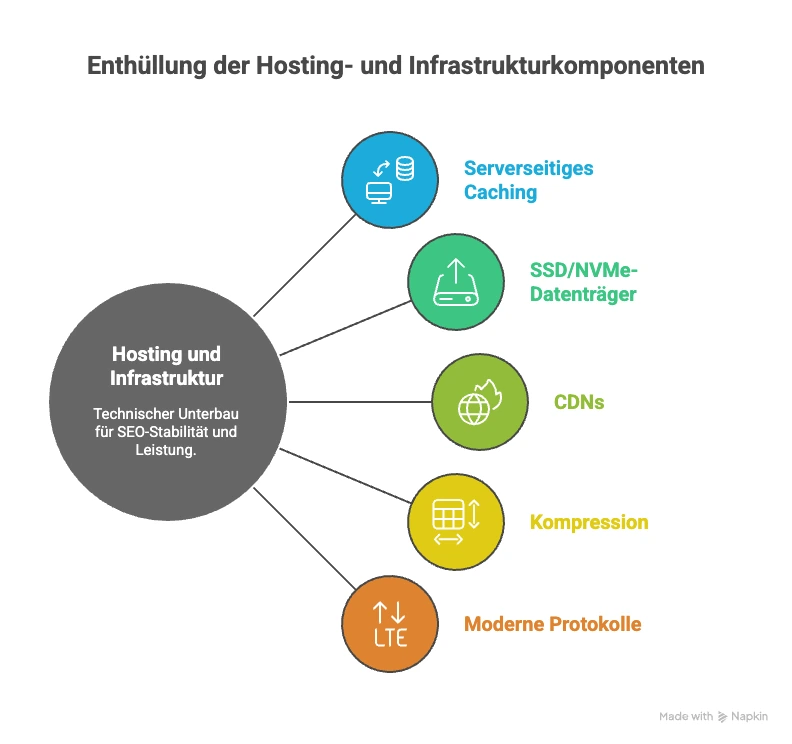
Typical technical components include:
- Server-side caching to avoid recalculating recurring requests.
- SSD/NVMe data carriers for fast data access.
- CDNs (content delivery networks) for worldwide delivery
- Compression (gzip, brotli) to reduce the amount of data
Modern protocols such as HTTP/3 for lower latencies
Scalable hosting setups such as maxcluster are designed to meet precisely these requirements and help shops remain stable even under high load.
Core Web Vitals: Google's performance indicators for your shop
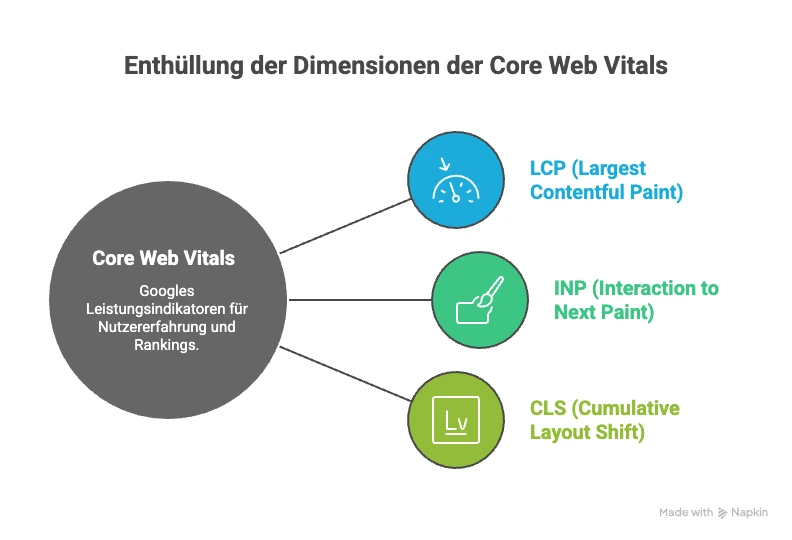
Core Web Vitals measure real user data and evaluate loading time, interaction, and visual stability. Good values have a positive effect on user satisfaction and rankings.
Important metrics:
- LCP (Largest Contentful Paint): The time at which the largest visible element is loaded
- INP (Interaction to Next Paint): Response speed to user interactions
- CLS (Cumulative Layout Shift): Unexpected layout shifts during loading.
Poor scores are often caused by large images, lack of caching, or blocking JavaScript. Regular performance checks help to identify problems early on and fix them in a targeted manner.
TTFB, caching, and databases: technical adjustments with a big impact
Online shops process a lot of data simultaneously: filters, variants, personalized content. If the server, cache, or database don't work together properly, loading times increase noticeably.
A typical example: a user filters a product list – and suddenly the page freezes. The cause is often not poor programming, but an overloaded database or a lack of caching.
Important levers are:
- TTFB: Long server responses indicate bottlenecks in the server, database, or cache.
- Caching: Without cache, each request is recalculated.
- Database & storage: Slow queries slow down filters, shopping carts, and checkout.
Powerful hosting setups use in-memory caches (e.g., Redis) or optimized search solutions to keep response times low.
Downtime, peak load, and error codes: invisible SEO brakes
Downtime, peak loads, and server errors are particularly critical—and often don't even show up in traditional analytics tools. However, they are immediately noticeable to Google and users.
Traffic increases significantly on promotional days such as Black Friday. If the infrastructure is not prepared for this, pages load slowly or deliver errors. In the short term, the conversion rate drops, and in the long term, rankings and trust suffer.
Monitoring systems, automatic failover mechanisms, and scalable setups help to mitigate such situations before they become an SEO problem.
Clean indexing instead of URL ballast: page architecture as an SEO lever
Crawl budget is limited. If Google crawls unnecessary filter or parameter URLs, important pages will be left behind. At the same time, too many URLs can negatively impact performance.
Recommendations:
- Exclude irrelevant URLs via robots.txt or noindex.
- Use canonical tags to merge variants.
- Use XML sitemaps to specifically signal important content.
This way, you can direct crawling and indexing to the pages that really bring visibility.
HTTPS: The basis for trust, security, and rankings
HTTPS ensures an encrypted connection between the browser and server. This is mandatory for online shops—legally, technically, and from an SEO perspective.
Google considers HTTPS a ranking factor, and modern browsers actively warn users about unsafe sites. Automated SSL certificates and regular monitoring prevent expired certificates from becoming a risk.
Mini roadmap: Taking a structured approach to technical SEO
| Step | Goal | Measures | Metrics & Tools |
|---|---|---|---|
| 1 | Measure baseline | Capture current status | Core Web Vitals, TTFB, 5XX errors |
| 2 | Create stability | Optimize hosting, cache, database | Uptime monitoring, load tests |
| 3 | Monitoring & optimization | Ensure long-term performance | Google Search Console (GSC), monitoring tools |
Conclusion
Technical SEO is the foundation for sustainable visibility in e-commerce. Fast loading times, stable availability, and clean indexing ensure that search engines reliably crawl your shop and users enjoy staying there.
The interaction between hosting, infrastructure, and SEO in particular shows how important it is to take a holistic view of technology—because only a stable foundation enables long-term growth.

About the author
Noah Lutz is a German online marketing specialist and freelancer who has been helping companies improve their visibility in search engines for over a decade through targeted SEO and SEA strategies.
Noah Lutz Online Marketing is a German-speaking online marketing agency specializing in search engine optimization (SEO), search engine advertising (SEA), and local visibility, using customized strategies to sustainably increase the visibility and reach of websites.